
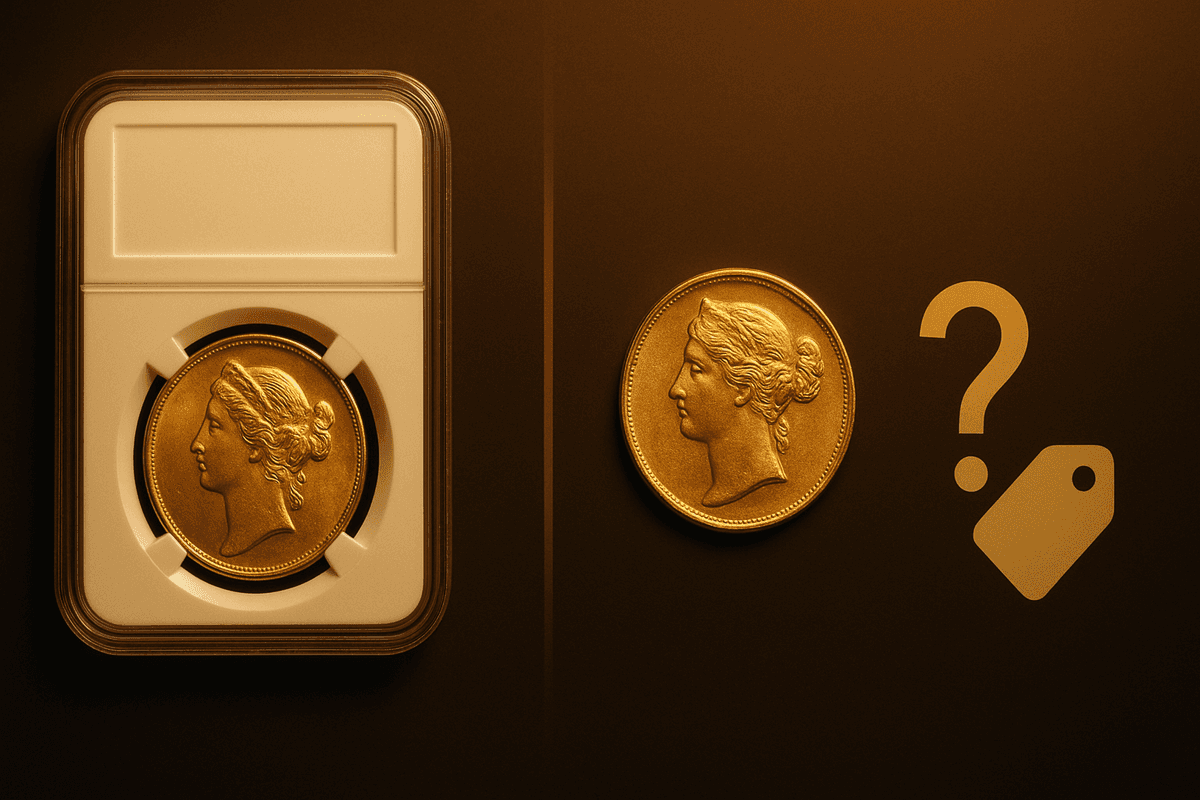
Two Questions, One Coin
When eBay announced earlier this month that collectible coins priced at $500 or more would receive professional authentication through PCGS at no extra cost, it was unambiguously good news for sellers. Counterfeits are the biggest trust killer in online coins, and a marketplace that verifies authenticity before the coin reaches the buyer removes the single most common reason a purchase falls apart.
But notice what authentication answers, and what it does not.
Authentication answers one question: is this coin genuine? It confirms the coin is real, and — when a grade is attached — that the grade is defensible. It does not answer the second question: what is this coin worth? A coin can be perfectly authentic and still be priced anywhere from "a steal" to "a mistake." The certificate proves existence. It does not establish value.
Where the Confusion Comes From
The confusion is understandable. A slabbed coin feels authoritative. It has a grade, a certification number, a professional name behind it. All of that signals legitimacy, and legitimacy feels a lot like value. But they are not the same thing.
Value is set by the market — by what comparable coins have actually sold for, in what condition, with what demand. A coin can be 100% genuine, professionally graded, and still have very few comparable sales to anchor its price. That is not a contradiction; it is just the difference between the two questions. The grade is a fact about the coin. The price is a fact about the market.
The risk shows up most sharply exactly where the new eBay policy lands: coins over $500. That is where key dates, condition rarities, and low-population coins live — the very coins where "genuine" is settled but "what's it worth" has genuinely thin data. A 1949-D Franklin half in MS-65 with Full Bell Lines is real. But how many of them have actually sold this year? That is the question a certificate cannot answer.
The Data Tells You Which Question You're Answering
This is why a confidence score is not a gimmick. LastSoldCoin's FloorBid gives you a single dealer-buy number. BidScore tells you — honestly — how much market data backs that number. A deep, liquid coin shows a high score: lots of comps, tight spreads, confident pricing. A thin-data rarity shows a lower score: the coin is real, but the market hasn't produced enough sales to pin down a tight value.
Authentication and BidScore are answers to two different questions, and you need both. The certificate says the coin is what it claims to be. The score says how confidently you can say what it's worth. A seller who has both — "this coin is PCGS-authenticated, and the BidScore on this grade is 82, meaning the comps are deep" — is giving the buyer the complete picture. A seller who has only the certificate is asking the buyer to bridge the gap on faith.
The Bottom Line
Celebrate the authentication news. It makes the marketplace safer and your job easier. But do not let a certificate do your pricing for you. "Genuine" is a fact about the coin. "Worth it" is a fact about the market. The first builds trust. The second builds the sale. You need both — and only one of them comes in a slab.
Price with the data, not just the certification. Your buyer is already doing both.
Answer both questions
Search any US coin on LastSoldCoin. FloorBid gives you the dealer-buy number, BidScore tells you how much real market data is behind it — the part a certificate can't tell you. Always visible. Always honest.
Try LastSoldCoin →