
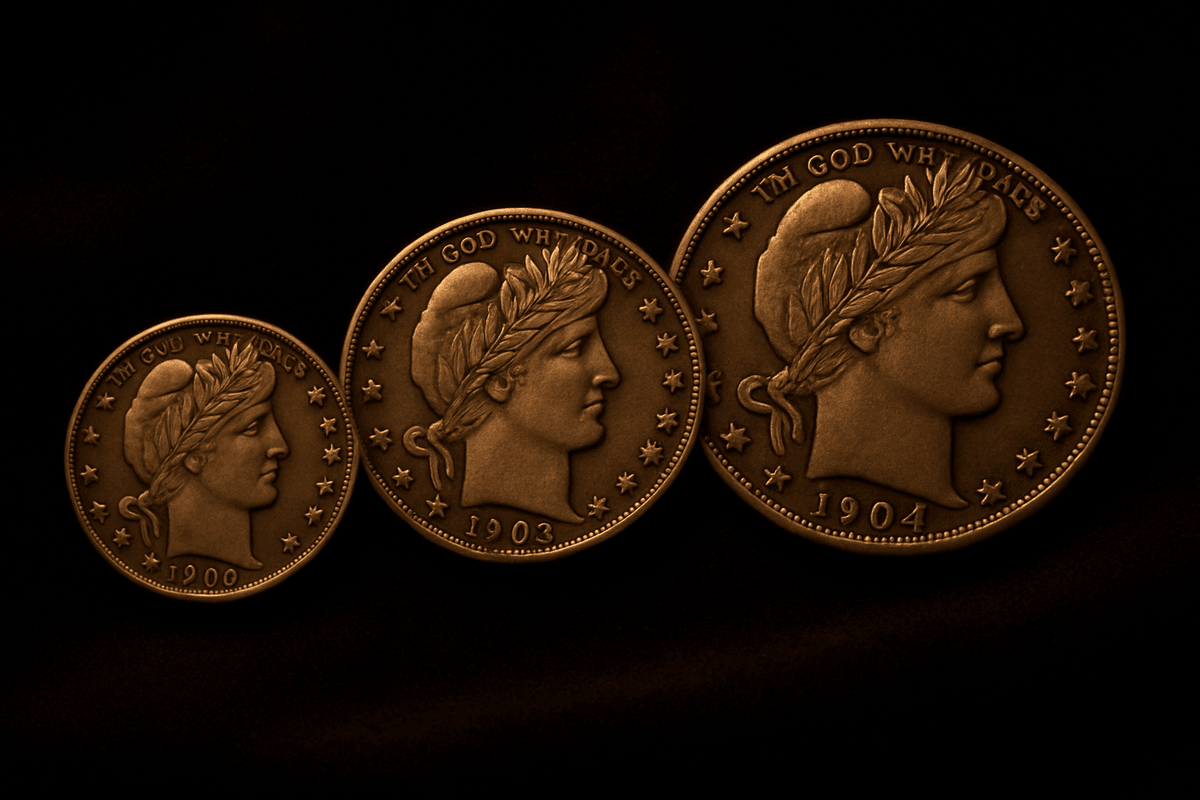
What Is Barber Coinage?
Barber coinage is the family of dimes, quarters, and half dollars designed by U.S. Mint Chief Engraver Charles E. Barber and struck from 1892 to 1916. All three denominations share the same Liberty Head obverse — a right-facing Liberty wearing a laurel wreath and Phrygian cap — and all three are composed of 90% silver.
That 90% silver content matters, because it gives every Barber coin a real, trackable melt floor before a single dollar of numismatic premium is added. At silver around $62.97 per ounce (mid-September 2026), the melt math works out to roughly $4.56 for a dime (0.07234 oz), $11.39 for a quarter (0.18084 oz), and $22.78 for a half dollar (0.36169 oz).
Above that floor, Barber values are driven entirely by date, mint mark, condition, and demand — and the spread between the most common date and the rarest is among the widest in all of American numismatics.
The Legendary Key: 1894-S Barber Dime
The 1894-S dime sits at the very top of the Barber family and of U.S. coin collecting as a whole. Only 24 were struck at the San Francisco Mint, making it one of the rarest regularly issued U.S. coins ever produced. Survivors are so scarce that the coin has been a "dream coin" for collectors for more than a century.
As of this month, there's a fresh, verifiable data point for exactly how scarce: Numismatic News reported (September 11, 2026) that an 1894-S Barber dime brought $1.25 millionat Stack's Bowers' Summer 2026 Global Showcase Rarities Night. That's a genuine, sourced auction result — and it's also the single least useful comp you could apply to any other Barber coin you'll ever touch.
That's the core lesson of this series: Barber coinage runs the full range from bullion to legendary rarity, and pricing it correctly means knowing which end of that range you're actually holding.
Barber Dimes: Semi-Keys and Thin-Data Dates
Below the 1894-S, Barber dimes have a well-known ladder of semi-key and key dates. The 1895-O (mintage 440,000) leads the pack, followed closely by the 1901-S, 1903-S, 1904-S, and 1913-S, plus the 1896-O, 1896-S, and 1897-O. Common Philadelphia dates and late-series San Francisco and Denver issues in circulated grades track much closer to melt.
Here's where honest pricing gets interesting. The semi-key dates — the 1895-O, 1901-S, and their neighbors — are exactly the coins where auction comps thin out. There aren't hundreds of sold examples a month to average; there might be a handful, and their prices can vary widely by grade. That's the "thin data" problem, and it's the single biggest reason sellers misprice mid-series Barbers.
The answer isn't to guess harder — it's to let the data tell you how much confidence you should have. A tool that gives you a dealer-buy number plus a confidence score based on how much real market data backs it is built exactly for this situation: a common date with deep comps gets a high-confidence number, while a semi-key with sparse sales gets flagged as thin-air territory so you can price it accordingly.
Barber Quarters: The 1913-S and Its Cousins
Barber quarters are anchored by the 1913-S, a coin with a mintage of just 40,000 that ranks as the undisputed key of the denomination. The 1896-S and 1901-S are the next rung down, and the 1909-O rounds out the short list of dates that command serious numismatic premium in any grade.
The 1913-S quarter is a favorite example of why grade matters so much at the top of a series. A well-worn circulated example is a genuinely scarce coin; an uncirculated one is a different universe entirely, with competition among registry-set builders pushing prices far beyond what a casual buyer might expect. If you ever come across a 1913-S quarter, do not quote it from a memory of "what quarters go for" — that's a thin-data key date, and it deserves a real comp check.
Barber Halves: The Quiet Overlooked Series
Barber half dollars are the most underappreciated of the three. The series has a cluster of keys — the 1892-O, 1892-S, 1893-S, 1897-O, 1897-S, and 1904-S — plus the famous low-mintage 1913 (188,000 struck) and its 1914 and 1915 neighbors, which round out a surprisingly scarce late-series run.
Because halves were heavily used and many were melted over the decades, surviving examples in attractive condition are scarcer than their raw mintages suggest. That makes condition a disproportionately important factor here — more so than on quarters and dimes, where circulation wear was less punishing on the larger design. For streamers and dealers, the Barber half is a series where "buy the coin, not the date" applies in full force.
How to Price Barber Coinage Honestly
The workflow is the same one that works for any 90% silver series, but the stakes are higher because the spread is wider. Start with melt — always know the silver floor. Then identify the exact date, mint mark, and grade, because a single letter (an S instead of no mint mark, an O instead of a P) can mean the difference between a $12 coin and a coin worth hundreds or more.
Finally, pull actual comparable sales for that exact coin, not for "a Barber quarter" in general. If the comps are deep, price with confidence. If they're thin, price with caution and say so. Buyers on a live stream can tell the difference between a number you looked up and a number you made up — and with a series this wide, that difference is worth real money on both sides of the table.
That's the whole pitch for a tool that shows its work. A dealer-buy number gives you a floor you can defend on stream; a confidence score tells you — and your buyer — how much real market data backs that number. For common-date Barbers that's deep data and high confidence; for the 1895-O dime or the 1913-S quarter, it's honest thin-air territory, and saying so is exactly what builds trust.
Price your Barber coins with real comps
Search any Barber dime, quarter, or half on LastSoldCoin. FloorBid gives you the dealer-buy number, BidScore tells you how confident it is — from common dates to the 1894-S and beyond.
Search a Coin →