
A Design That Defined an Era
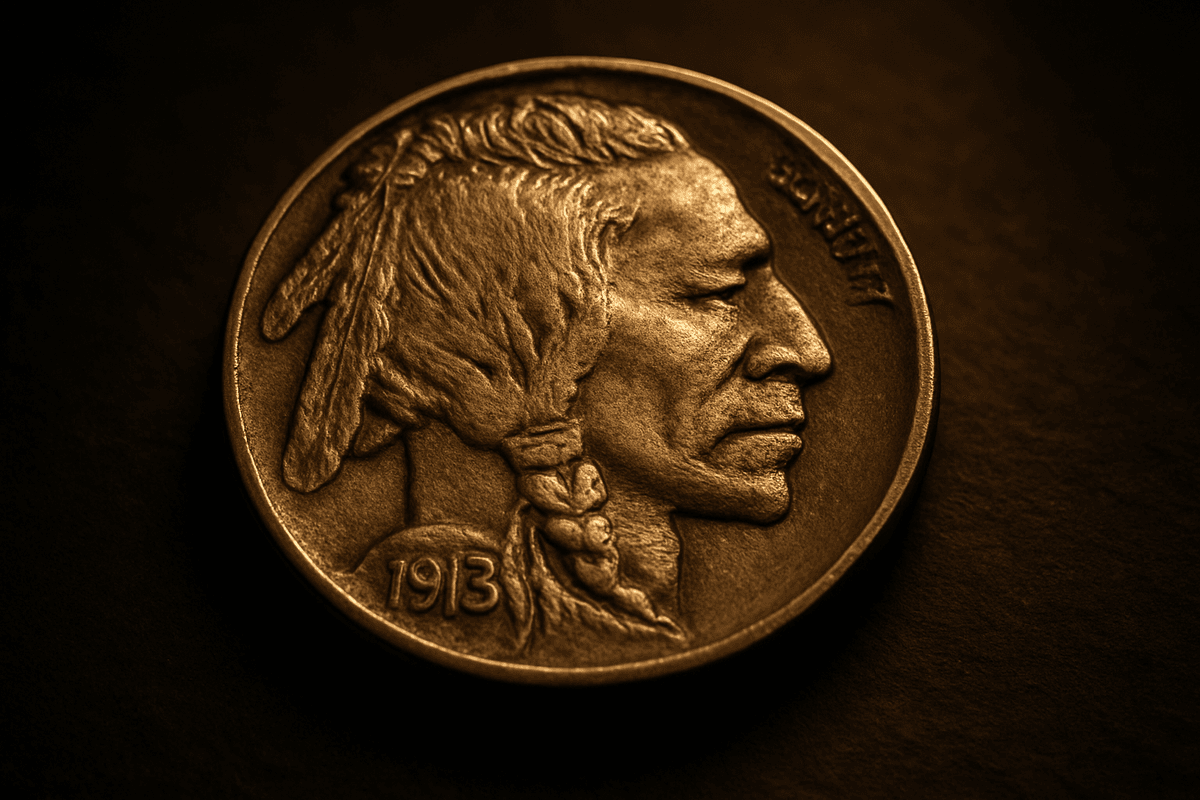
The Buffalo nickel was designed by sculptor James Earle Fraser and struck from 1913 to 1938. The obverse — despite the nickname — is not a portrait of one person; it's a composite of three Native American chiefs whose features Fraser combined into a single dignified profile. The reverse shows an American bison, the model often identified as "Black Diamond," a famous animal of the era.
It's a base-metal coin — 75% copper and 25% nickel — so there's no silver melt floor underneath it. That's the first and most important pricing fact about this series: a Buffalo nickel's value is almost entirely numismatic. It comes from rarity, condition, and demand, not from the metal. Which means honest comps matter here more than almost anywhere else.
The Famous Flaw: A Date That Wears Away
Buffalo nickels have a well-known design problem. The date sits on a raised "mound" beneath the chief's shoulder — the highest point on the obverse and therefore the very first detail to wear away in circulation. The result is that dateless Buffalo nickels are shockingly common. You can find an otherwise legible coin whose date has simply been rubbed smooth.
This matters for pricing because the date is the whole key. A dateless Buffalo nickel is worth only a small premium as a curiosity or a "filler" — you literally cannot value it as a specific date until you identify it. And a coin that requires acid-based "date restoration" to read has been damaged, which makes it worth less than a naturally readable example, not more.
There's even an early-chapter version of the flaw. The very first 1913 nickels — now called Type 1 — placed the bison on a raised mound with "FIVE CENTS" raised as well, where it wore off quickly. Partway through 1913 the Mint flattened the mound so the denomination could be recessed, producing the Type 2 design that became standard. The Type 1 is the scarcer of the two early varieties.
The Keys and Famous Varieties
The Buffalo nickel series has a handful of coins that tower over the rest. The 1913-S Type 2 is the undisputed key — struck in San Francisco in the series' first year, it's been sought after for over a century. Other dates, like the 1914-D and 1921-S, round out the short list of scarcer business strikes.
Then there are the famous varieties, and Buffalo nickels have more than their share. The 1918/7-D is an overdate, with a 7 visibly punched beneath the 8. The 1916 doubled die shows a doubled date. And the 1937-D "three-legged" buffalo is one of the most celebrated errors in all of American coinage — the result of an over-polished die that removed one of the bison's front legs.
These are exactly the coins where a confidence score earns its keep. A common-date Buffalo nickel in a typical grade has plenty of recent comps; a 1913-S Type 2 or a 1937-D three-legged buffalo does not. When the data is thin, the honest move is to say so — and to price with the uncertainty you actually have.
How to Value a Buffalo Nickel Honestly
Start with the date and mint mark — and understand that if you can't read the date, you're holding a different coin than the one you'd like it to be. The mint mark sits on the reverse, beneath the bison, and it's a key piece of the puzzle for the scarcer issues.
Then judge condition realistically. Buffalo nickels are a copper-nickel coin, and they wear in predictable ways: the date goes first, then the high points of the chief's headdress and the bison's shoulder. A "full horn" on the bison is a well-known shorthand for a strong strike and good surfaces, but the honest price always comes back to actual comparable sales for the exact date, mint mark, and grade in front of you.
That's the whole philosophy behind a tool that shows its work. A dealer-buy number gives you a floor you can defend, and a confidence score tells you — and your buyer — how much real market data backs it. On a series with no melt floor and a date that hides from you, showing that work isn't optional. It's the only way to know what you actually have.
Price your nickels with real comps
Search any Buffalo nickel on LastSoldCoin. FloorBid gives you the dealer-buy number, BidScore tells you how confident it is — from common 1930s dates to the 1913-S Type 2 and three-legged keys.
Search a Coin →