
A Short, Clean, Silver-Rich Series
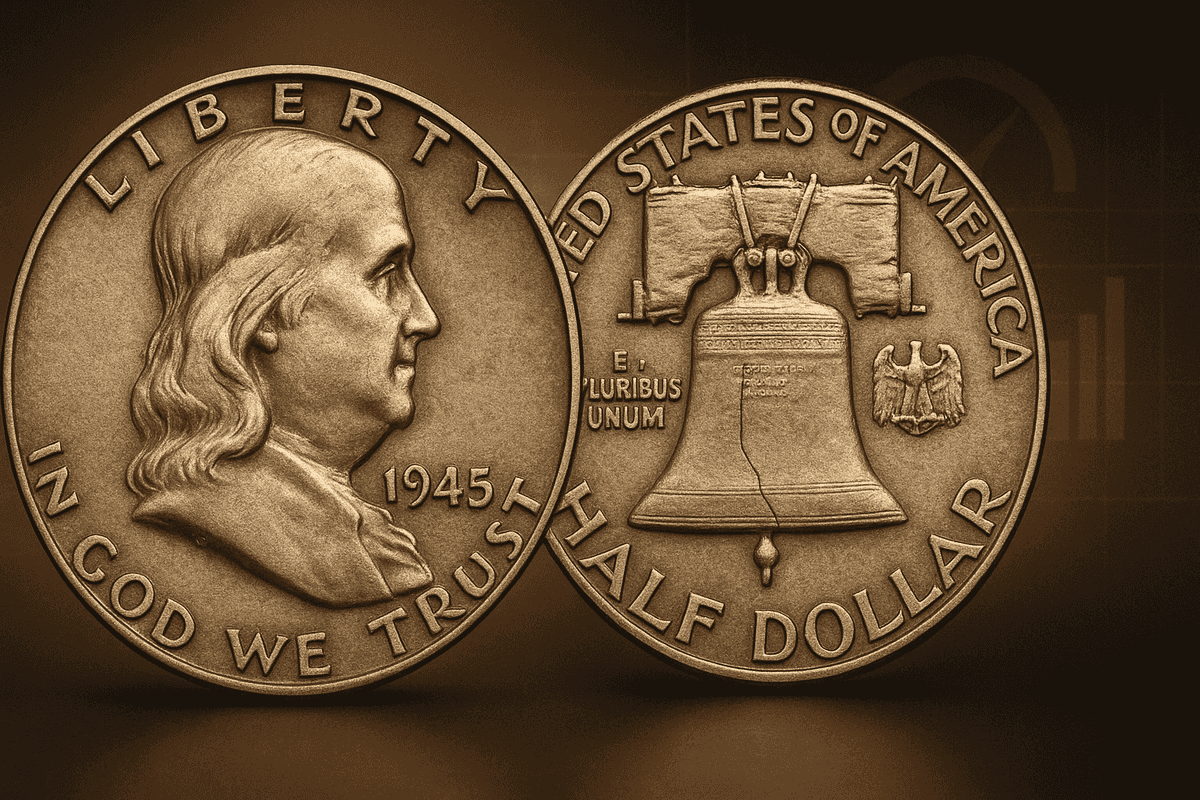
The Franklin half dollar, designed by John R. Sinnock and struck from 1948 through 1963, is one of the shortest regular U.S. coin series — just 16 years before the Kennedy half replaced it. The obverse bears Benjamin Franklin's portrait, and the reverse carries the Liberty Bell with a small eagle at its side, added because the law required an eagle on half dollars.
Every Franklin half is 90% silver (0.36169 troy ounces each), struck at the Philadelphia, Denver, and San Francisco mints. That matters for pricing, because unlike a clad Kennedy half, a Franklin half always has a meaningful melt floor beneath it. No matter how common the date, the coin is never worth less than its silver content — which, with silver trading around $66 an ounce in September 2026, is roughly $24 per coin.
Silver Melt Context (September 2026)
At $66.30 per troy ounce (September 7, 2026), every Franklin half carries roughly $23.98 in melt value. Common circulated dates — and there are plenty of them — trade at modest premiums above that floor. The coin's worth in the bulk market is, in other words, mostly its metal.
The moment you move beyond circulated common dates, though, the melt floor stops being the story and becomes merely a backstop. Uncirculated Franklin halves carry a real numismatic premium, and at the very top of the grade scale the price is driven almost entirely by condition scarcity — not by silver at all.
The "Full Bell Lines" Condition Rarity
Franklin halves have a famous condition metric: Full Bell Lines (FBL), awarded when the horizontal lines across the bottom of the Liberty Bell are fully struck and unbroken. Most uncirculated Franklin halves are not FBL — the lower set of bell lines is notoriously weak on this design, and the dies often struck them softly.
This is where the series gets interesting for honest pricing. A common-date Franklin half in MS-63 is one thing; the same coin with a Full Bell Lines designation is a materially rarer and pricier object. The gap is real, it is persistent, and it is exactly the kind of distinction that an untrained eye — or a seller quoting from memory — will miss. If you cannot tell whether a Franklin half has full bell lines, you should not be pricing it as if you can.
Key and Semi-Key Dates
- 1949-D and 1949-S. The two lowest-mintage business strikes of the series, and the dates collectors chase first. In high grades with Full Bell Lines, they command a substantial premium over common dates.
- 1955. A lower-mintage Philadelphia issue that sits alongside the 1949s as a recognized semi-key.
- 1956. Another semi-key in the series' second half, frequently included in any serious date set.
- Proofs (1950–1963). The Mint struck proof Franklin halves every year from 1950 onward, in two main finishes — the earlier proofs and the later "Type 2" style — and Cameo and Deep Cameo examples are the top end of the series in terms of eye appeal and price.
A word on the "Bugs Bunny" variety: on certain 1955 Franklin halves, a die clash created what looks like a second set of front teeth on Franklin — hence the nickname. It is a beloved, widely collected error variety, and it carries a premium over a normal 1955, though attribution matters and not every "Bugs Bunny" claim holds up under scrutiny.
How to Price a Franklin Half Honestly on Stream
- Establish the floor (5 seconds). Confirm it is a 90% silver Franklin half. If it is circulated and common, you are pricing silver-plus-a-little — a high-BidScore, liquid market where you can move fast.
- Check the bell lines (5 seconds). This is the single highest-value detail on uncirculated Franklins. Full Bell Lines transforms a common date's worth. If you are unsure, price conservatively — the FBL distinction is where sellers leave the most money on the table.
- Spot the key dates (5 seconds). 1949-D and 1949-S first, then 1955 and 1956. These trade on scarcity and condition, not on melt.
- Pull the FloorBid and BidScore (5 seconds).Search the coin on LastSoldCoin. The FloorBid number is your dealer-buy estimate; the BidScore tells you how much data backs it. A circulated common date shows a high BidScore — deep, liquid comps. A 1949-D in MS-65 FBL shows a lower one — real data, but sparse.
- Set the price (5 seconds). Common circulated: melt-plus, sell volume. Uncirculated FBL and key dates: let the BidScore set your margin — high score, price aggressively; low score, widen the spread and disclose the thinner data.
The Honest-Pricing Lesson in the Franklin Series
The Franklin half is the rare series that is simultaneously easy and hard to price. Easy, because every coin has a silver floor and the common dates are liquid. Hard, because the premium at the top — Full Bell Lines, Cameo proofs, the key dates — is driven by condition scarcity that is genuinely thin in the data.
That is exactly what FloorBid and BidScore are built for: one number for the dealer-buy price, one score for how much market data is actually behind it. When you can tell a buyer "the FloorBid on this 1949-D in MS-65 FBL is $X and the BidScore is 58 — real comps but a thin population," you are not just quoting a number. You are showing your work, and that closes sales.
Price any Franklin half in seconds
Search a 1949-D or a common 1963 on LastSoldCoin. FloorBid gives you the dealer-buy number, BidScore tells you how much data is behind it — from melt-anchored common dates to thin-air FBL keys. Always visible. Always honest.
Search a Franklin Half →