
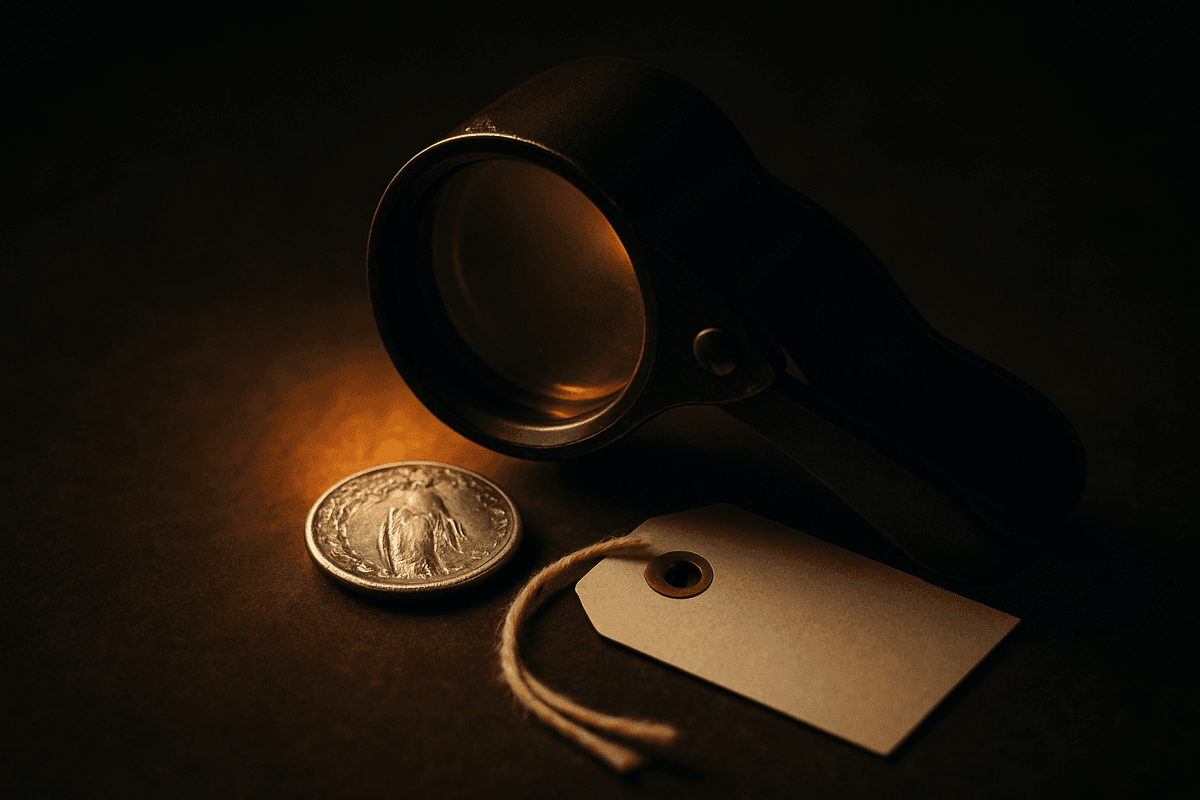
The Grading Fee Doesn't Care What Your Coin Is Worth
Third-party grading is a flat fee. It costs the same to slab a coin worth five dollars as it does a coin worth five thousand. That single fact is the entire economics of the decision, and it's the part almost nobody stops to think through.
If you pay a fixed amount to get a coin graded and the grade doesn't meaningfully change what you can sell it for, you have lost money — every time. You haven't added value to the coin; you've added a receipt. And a receipt for "this is a common coin in a common grade" is not worth what you paid to get it.
When the Slab Is Actually Worth It
Grading earns its keep in a few specific situations. When the grade itself moves the price dramatically — think the jump between one grade and the next on a key date, where a single point can mean a lot of money — then paying to establish that grade makes sense. When authentication is the point, a slab from a respected service protects against counterfeits and altered coins. And when a coin sits right on the line between a straight grade and a "details" grade, the distinction changes the price enough that getting it settled is worth the fee.
What do all those situations have in common? The value at stake is larger than the cost of the slab. That's the test. If the possible swing in price is smaller than the grading fee, you're not making an investment decision — you're paying for peace of mind, and you should call it that.
The Common Coin Is the Trap
The trap is the common coin in decent shape. A 1940s Wheat cent, a 1964 Kennedy half, a circulated 1943-P nickel — these are coins people love, and love makes people over-grade their own expectations. You find one, it looks nice, and you convince yourself it might be "worth something" if only it were slabbed.
Here's the honest version: the grade on a common coin usually doesn't move the needle much, because there are a lot of them in every grade. The market already knows what a common-date coin in typical condition is worth. Slabbing it doesn't make it scarce; it just makes it confirmed. And confirming the obvious is a losing use of a fixed fee.
The same logic applies to the other side of the trade. If a seller is asking a big premium because a common coin is slabbed, ask what the slab is actually adding. Authentication matters on a coin that's widely counterfeited or altered. On a common-date coin in an ordinary grade, the plastic is doing very little work beyond making the price look more official.
Know the Value Before You Pay to Confirm It
This is where honest pricing does its real job: you should have a sense of what a coin is worth before you spend money to confirm it. That's the whole point of checking real comparable sales for the exact date, mint mark, and condition in front of you — not a memorized number, not a hope, actual recent sales.
A dealer-buy number tells you the floor you can actually get. A confidence score tells you how much real data is behind that number — deep comps or thin air. Armed with those two things, the grading decision makes itself: if the spread between "what it's worth raw" and "what it's worth graded" is bigger than the fee, grade it. If it isn't, keep your money and sell the coin for what it is.
So the next time you're tempted to slab a coin out of habit, ask the honest question first: is the grade going to change the price by more than the grading costs? If you don't know the answer, you don't know the value yet — and that's the thing to find out before you spend a dime.
Know the value before you slab it
Search any US coin on LastSoldCoin. FloorBid gives you the dealer-buy number, BidScore tells you how much data backs it — so you can decide whether grading is worth it before you pay.
Search a Coin →