
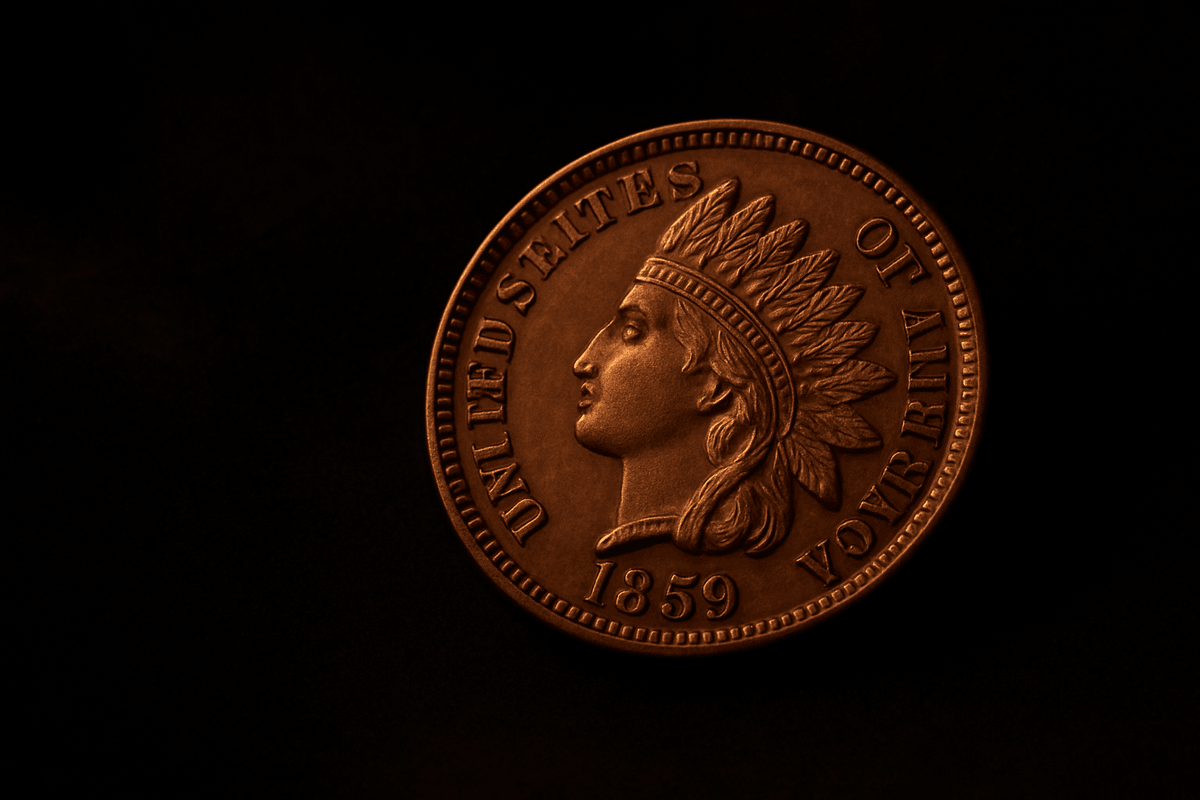
A Quick History of the Indian Head Cent
The Indian Head cent was designed by U.S. Mint Chief Engraver James B. Longacre and struck from 1859 to 1909, following the short-lived Flying Eagle cent (1856–1858). The obverse — despite the name — does not depict a Native American; it shows Liberty wearing a feathered headdress, an allegorical figure that was common in American art of the era.
Two details make the series especially interesting for collectors. First, the composition changed mid-run: early cents (1859–1864) were struck in a hard copper-nickel alloy, while later issues (1864–1909) switched to a softer bronze. Second, the reverse design evolved — the 1859 debut carried a simple laurel wreath, and in 1860 the Mint added the oak wreath and shield we now associate with the series.
One thing to keep in mind right away: these are base-metal coins. There's no meaningful silver or gold content here, so there's no melt floor to lean on. An Indian Head cent's value is almost entirely numismatic — it comes from rarity, condition, and demand, which makes honest comps more important here than almost anywhere else.
The Keys: 1877 and 1909-S
Every series has its keys, and Indian Head cents have two that tower over the rest. The 1877 is the undisputed king — it has the lowest mintage of the entire series, and it's been a sought-after date for well over a century. The 1909-S, struck in the series' final year, is the other heavyweight, with a small San Francisco mintage that makes even well-worn examples genuinely scarce.
Here's where honest pricing gets real. These two dates are exactly the kind of coins where a casual buyer gets hurt — a 1909-S Indian Head cent is worth dramatically more than a common 1907 or 1908, and a counterfeit or altered example is a real risk precisely because the premium is so high. If you have one of these, don't guess: pull actual sold comps for the exact date, mint mark, and grade.
The Famous Varieties: 1864-L and the 1869 Overdate
Indian Head cents have a couple of famous varieties worth knowing. The 1864-L carries a small "L" — Longacre's initial — on the ribbon of the headdress, a detail that was added partway through 1864 production and makes the "L" variety the scarcer of the two 1864 types. The 1869/9 is a repunched-date overdate that sharp-eyed collectors have prized for generations.
Varieties like these are where a confidence score earns its keep. An 1864 without the "L" is a different coin than one with it, and the market treats them differently. If you're not sure which one you're looking at, that uncertainty should be reflected in how confidently you price it — not papered over with a single memorized number.
The Rest of the Series: Common Dates in the Middle
Between the keys, Indian Head cents are a remarkably approachable series. Common dates from the 1880s through the early 1900s are plentiful in circulated grades, and the 1860s bronze dates — the 1864 through 1869 issues in particular — are collected both by date and by grade. Semi-keys like the 1872 and 1908-S round out the ladder for more serious collectors.
The practical takeaway for anyone buying or selling: condition matters enormously on a copper coin. Copper tones and wears differently than silver, and a "red" (full original luster) Indian Head cent can command a meaningful premium over a "brown" example of the same date and grade. Color, surfaces, and eye appeal aren't afterthoughts here — they're part of the price.
How to Value an Indian Head Cent Honestly
Start by identifying exactly what you have: the date, the mint mark (on the reverse below the wreath), and the variety — the "L" on an 1864, the overdate on an 1869. That step alone separates the common-date cents from the coins that actually carry premium.
Then pull real comparable sales for that exact coin, in the grade it's actually in. Because there's no melt floor to catch you, the comps are the entire game. Deep data on a common 1905 gives you a tight, defensible range; thin data on an 1877 or 1909-S means pricing with caution and saying so out loud.
That's the whole philosophy behind a tool that shows its work. A dealer-buy number gives you a floor you can defend, and a confidence score tells you — and your buyer — how much real market data backs it. On a series where value lives entirely in rarity and grade, showing that work isn't optional. It's the whole ballgame.
As the penny itself moves closer to history, Indian Head cents are a fitting way to remember why the denomination mattered in the first place — and a reminder that "common" and "collectible" were never really about the metal.
Price your cents with real comps
Search any Indian Head cent on LastSoldCoin. FloorBid gives you the dealer-buy number, BidScore tells you how confident it is — from common 1900s dates to the 1877 and 1909-S keys.
Search a Coin →