
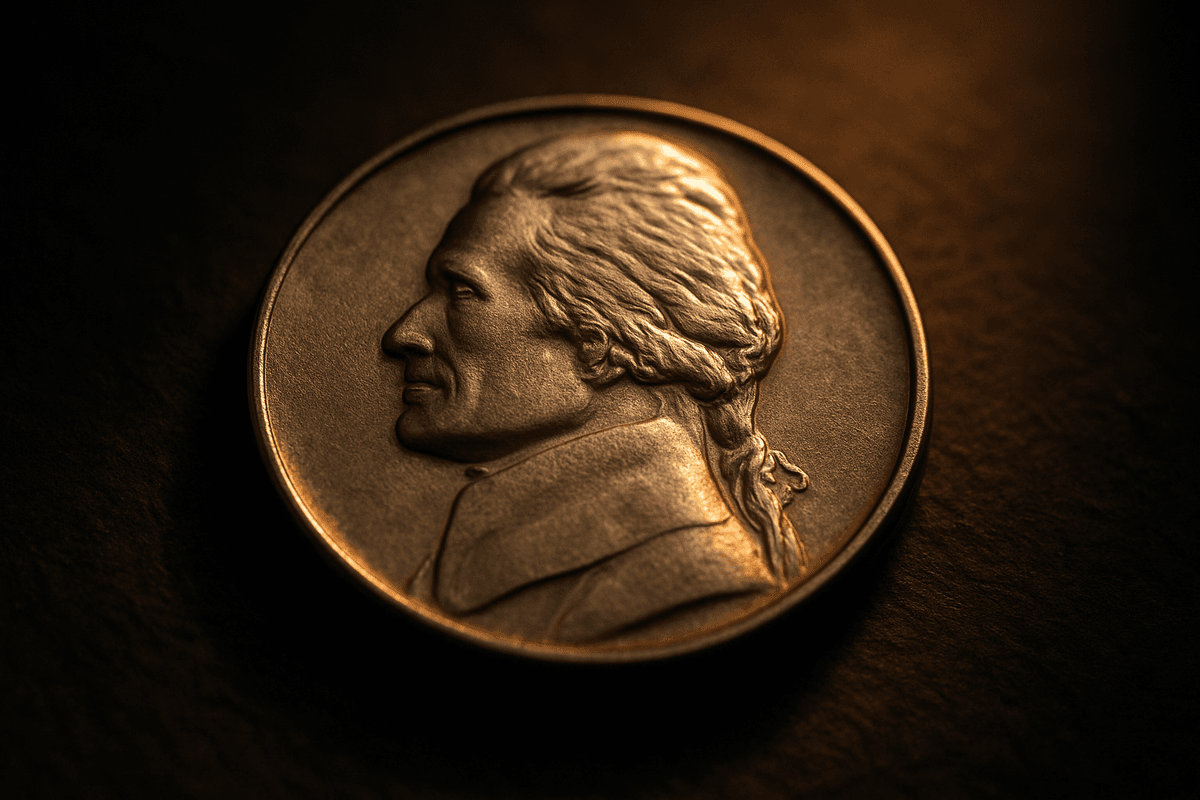
A Design Built to Last
The Jefferson nickel, designed by sculptor Felix Schlag, first entered circulation in 1938 — and it's still with us today. The obverse carries Thomas Jefferson's profile; the reverse shows his Virginia home, Monticello. It's a base-metal coin — normally 75% copper and 25% nickel — so for most dates there's no melt floor underneath it.
That makes this series a pure test of rarity and condition. A common-date Jefferson nickel in circulated shape is worth, well, about a nickel. The value shows up when you land on a key date, a famous variety, or one very specific four-year stretch we'll get to in a moment.
The Secret Silver Years: 1942–1945
Here's the part that surprises people: during World War II, the Mint needed nickel for the war effort, so it changed the composition of the five-cent piece. From 1942 through 1945, nickels were struck in an alloy that included 35% silver — the famous "wartime nickels."
That silver gives wartime nickels a small but real melt value tied to the price of silver, in a series that otherwise has no metal floor. And they're easy to spot: the wartime issues carry a large mint mark above the dome of Monticello on the reverse — and 1942–1945 is the only time the Philadelphia Mint ever placed a "P" on a U.S. coin. No other Jefferson nickel has that.
It's a great example of why you check the date and reverse before you price a nickel. Two coins that look nearly identical — a 1945 and a 1946 — sit on opposite sides of a real difference. One has silver in it; the other doesn't.
The Key Date and the Famous Varieties
The undisputed key of the series is the 1950-D, struck in Denver with a famously small mintage. It's been chased by collectors for decades and stands alone as the date that turns an ordinary nickel into a real find.
Then there are the varieties. The 1939 doubled die reverse shows clear doubling on "MONTICELLO" and "FIVE CENTS." And the 1943-P 3-over-2 overdate — a wartime nickel with a visible "3" punched over a "2" in the date — is one of the series' most celebrated errors.
These are exactly the coins where a confidence score earns its keep. A common-date Jefferson nickel has a thick, liquid market; a 1950-D in a high grade, or a 1943-P 3-over-2, does not. When the comps thin out, the honest move is to say so — and to price with the uncertainty you actually have.
How to Value a Jefferson Nickel Honestly
Start with the date and mint mark. The mint mark sits to the right of Monticello on the reverse (or above it, on the wartime silver years). Then check whether you're in the 1942–1945 window — that's your metal floor. Finally, judge condition realistically: Jefferson's hair and the steps of Monticello wear first, and a crisp, full strike on the reverse steps is the thing serious collectors look for.
But the honest price always comes back to actual comparable sales for the exact date, mint mark, and grade in front of you — not a memorized number. That's the whole point of showing your work: a dealer-buy number gives you a floor you can defend, and a confidence score tells you — and your buyer — how much real market data backs it.
On a series where most coins are worth a nickel but a handful are worth real money, that discipline is how you tell the difference without guessing.
Price your nickels with real comps
Search any Jefferson nickel on LastSoldCoin. FloorBid gives you the dealer-buy number, BidScore tells you how confident it is — from common dates and wartime silver to the 1950-D key.
Search a Coin →