
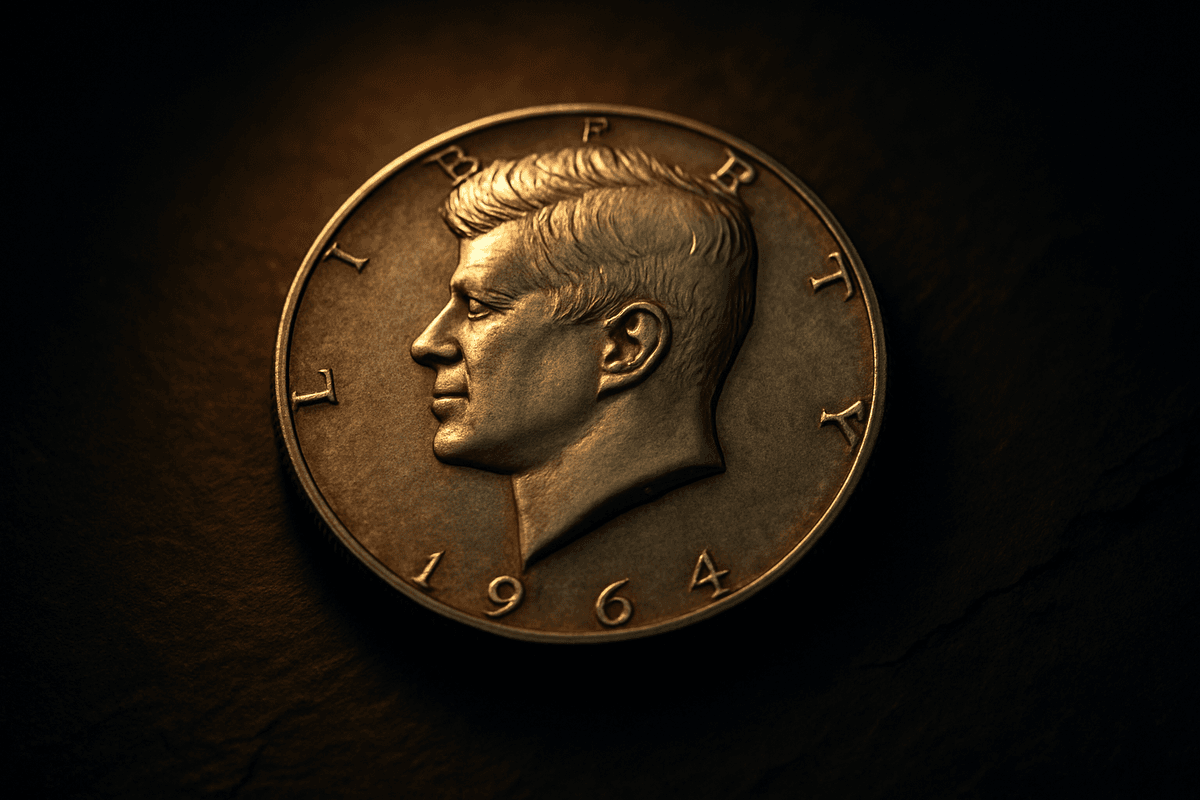
A Coin Born from a National Moment
The Kennedy half dollar debuted in 1964, struck to honor President John F. Kennedy in the wake of his 1963 assassination. The design — a portrait of Kennedy on the obverse and the presidential seal on the reverse — was adapted from the president's inaugural medal, and the coin was an instant hit with the public.
That popularity had a side effect that still shapes the market today: the first-year coins were hoarded rather than spent, in numbers so large that the Mint produced them in enormous quantities. That's the first thing to understand about this series — the early silver halves are plentiful, and their value lives more in the metal than in the date.
The Silver-to-Clad Divide: Three Different Coins
Kennedy halves actually split into three distinct groups, and this is where most pricing mistakes happen:
1964 halves are struck in the traditional 90% silver alloy, carrying 0.36169 troy ounces of silver. 1965 through 1970 halves were struck in a reduced 40% silver alloy, carrying about 0.1479 troy ounces of silver. Then from 1971 onward, the silver disappeared entirely — those halves are copper-nickel clad, with no precious-metal content at all.
The practical rule of thumb: check the date, not the look. A 1967 half and a 1972 half can look nearly identical at a glance, but one carries silver and the other doesn't. That one detail changes the floor under the coin entirely.
The Melt Floor, and Why It Matters Here
Because the early halves are silver, they carry a hard melt floor that moves with the spot price. At the time of writing (September 28, 2026), silver traded at roughly $61.83 per troy ounce, which puts the melt value of a 90% silver Kennedy half at roughly $22.36(0.36169 oz) and a 40% silver half at roughly $9.14 (0.1479 oz).
Two things follow from that. First, a common-date 1964 half is worth at least its silver, and in the current environment that floor is higher than many people assume. Second, the clad halves from 1971 onward have no such floor — most are worth face value or a small premium, and only the keys and high-grade proofs carry real numismatic value. Knowing which camp your coin falls into is step one.
The Key Dates: 1970-D and 1998-S
Every series has its keys, and Kennedy halves have two that matter most. The 1970-D is the famous one: it was struck only at Denver and released only inside 1970 mint sets — never issued for general circulation. That makes it the scarcest business-strike Kennedy half of the 40% silver era.
On the modern side, the 1998-S Special Mint Sethalf — struck with a distinctive matte finish and a low mintage — is the series' modern key. It's a reminder that "modern" doesn't automatically mean "common": a few post-1971 dates carry real premium for collectors who know to look.
Proofs are their own lane, too. Proof Kennedy halves were struck in silver for much of the series and remain popular with collectors, but a proof's value depends heavily on condition and whether it carries a cameo or deep-cameo contrast. As always, the exact issue and grade — not just "it's a proof" — determines the price.
How to Value a Kennedy Half Honestly
Start with the date. That single fact tells you which of the three camps you're in — 90% silver, 40% silver, or clad — and whether there's a melt floor underneath you. Then check the mint mark (on the reverse, to the left of the eagle's tail on early issues) to separate the keys from the common dates.
Then pull real comparable sales for that exact coin. For a common-date silver half, the melt floor anchors the low end and condition adds the premium. For a 1970-D or a 1998-S, the comps are the whole game — and those are exactly the thin-data coins where a confidence score earns its keep. Deep data on a common 1964 gives you a tight range; a key date in an unusual grade means pricing with caution and saying so out loud.
That's the whole philosophy behind a tool that shows its work. A dealer-buy number gives you a floor you can defend, and a confidence score tells you — and your buyer — how much real market data backs it. On a series that splits so cleanly between metal and numismatic value, showing that work isn't optional. It's the difference between knowing what you have and guessing.
Price your halves with real comps
Search any Kennedy half dollar on LastSoldCoin. FloorBid gives you the dealer-buy number, BidScore tells you how confident it is — from melt-floor 1964s to the 1970-D and 1998-S keys.
Search a Coin →