
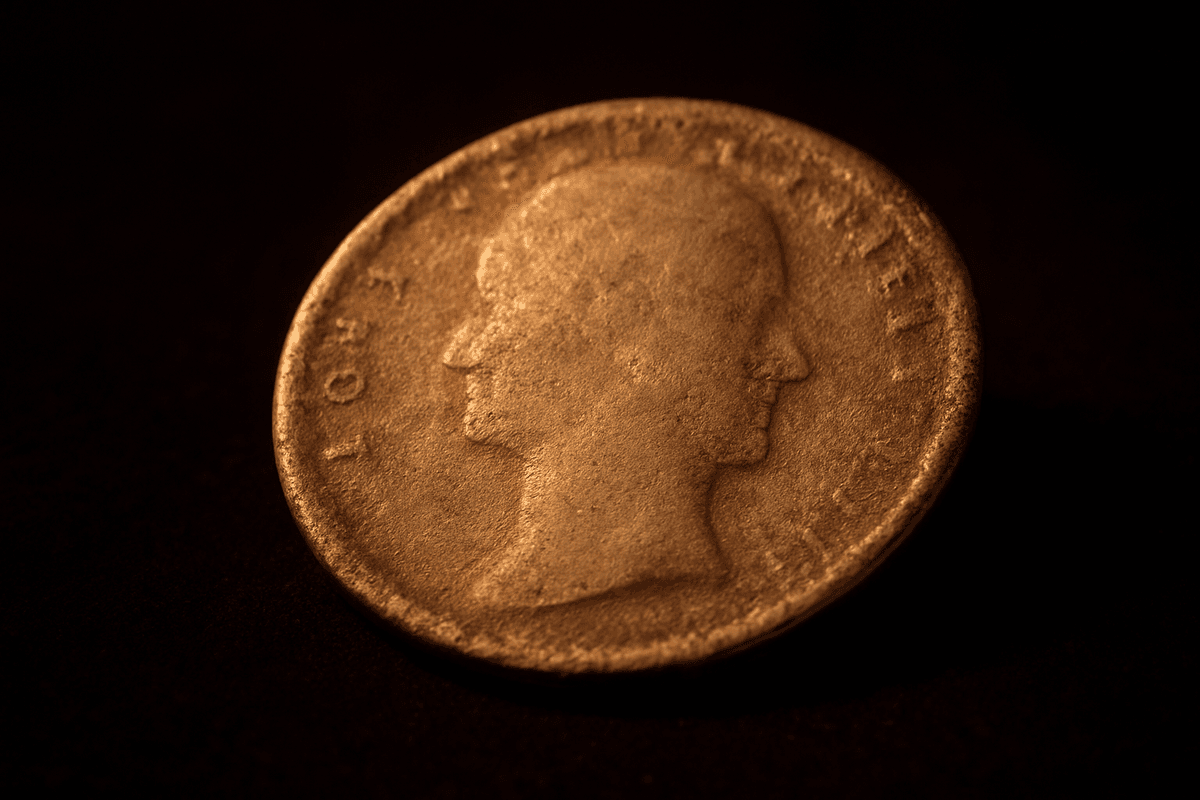
Two Ways a "Worse" Coin Becomes the Better Coin
The belief that "higher grade always means higher value" breaks down in two separate ways, and they're both real, documented market phenomena — not dealer lore.
The first is lowball collecting: a niche of collectors who deliberately build sets out of the lowest-grade examples they can find. The second is population inversion: dates and series where mint-state examples are actually more common than circulated ones, because the coin was recognized as valuable early and hoarded before it could wear. Understanding both is the difference between pricing a "wreck" as junk and recognizing it as the scarce coin it genuinely is.
First, the Grade Scale — and Why the Bottom Is Narrow
The coin-grading scale runs from 1 to 70, known as the Sheldon scale. At the very bottom sits PO-1, called "Poor" (or "Basal State") — a coin so worn that most of the design is gone, but which still retains enough to be identified. Just above it are Fair-2 (FR-2) and About Good-3 (AG-3), the grades where a coin is recognizable but nearly slick.
Here's the key: the bottom of the scale is a narrow band. Most coins that wear down that far don't land in PO-1 and stay there — they keep wearing until they're unidentifiable, or they get cleaned, holed, corroded, or otherwise damaged along the way. A coin that reaches PO-1 while staying whole, fully dated, and problem-free is the exception, not the rule.
The Lowball Niche: Collecting the Bottom of the Scale
Lowball collecting flips the usual goal. Instead of a set of the highest-graded coins, a lowball collector wants the lowest-graded, most thoroughly-worn examples of each coin — a "Poor Man's set," taken literally. The chase isn't for perfection; it's for the coin that has been worn as far as a coin can go while still being a coin.
The set registries made this a formal competition. The grading services operate registry programs where collectors compete against each other on leaderboards, and each coin in a set is assigned a value based on its relative scarcity. That scoring mechanic — "rarity, not grade" — is exactly what gives the lowball niche its economics: a problem-free PO-1 can be scarcer than a technically "better" coin two or three grades higher, and the market has learned to price it that way.
Population Inversion: When Mint State Is the Common Grade
The second phenomenon is even more counterintuitive, and it's one the population reports — the running census of every coin a grading service has certified — reveal directly. As numismatic researchers have long noted, studying those databases over time shows that "coins previously believed to be rare have turned out to be surprisingly common, while others assumed to be common have revealed themselves to be more scarce than initially thought."
The cleanest, best-documented example is the 1950-D Jefferson nickel. When it became known that the Denver Mint had struck only 2,630,030 nickels in 1950 — a fraction of a typical year's output — the coins "began to be widely hoarded." Collectors and speculators pulled them out of circulation in rolls and bags before they could wear. The result, as the historical record puts it: "Because they were so widely pulled from circulation, the 1950-D is readily available today."
Read that sentence twice, because it's the whole point: the 1950-D nickel is more common in high grade than in worn grade. People saved the nice ones and spent nothing. A circulated, heavily-worn 1950-D is the scarcer find — the exact opposite of what a beginner would guess from mintage alone.
Why It Happens: Survivorship, Running Backward
Both phenomena come from the same underlying force: survivorship. In most series, high-grade coins are scarce because people spent the coins — they circulated, wore down, and the survivors that got tucked away in high grade are the minority. That's the normal pattern.
Inversion happens when the normal pattern runs backward: when a coin is recognized as valuable while it's still being made, people save it before it can circulate. The high-grade population balloons, and the worn population shrinks — because nobody let the coin wear. The 1950-D nickel is the textbook case, and the same dynamic plays out across classic commemoratives and other early-hoarded key dates.
At the other end of the scale, the lowball premium is also a survivorship story: the coin that wears all the way to PO-1 without picking up damage is a survivor of a different kind. Both extremes are rare, just for opposite reasons — and both are priced by a small number of real sales, not by a big liquid market.
What This Means When You're Pricing One Live
Here's the practical takeaway for a streamer or dealer holding a coin that "looks too worn to be worth anything." Before you price it, answer two questions. Is it problem-free — whole, fully dated, no cleaning, holes, or corrosion? And is it a date or series where the high-grade population got hoarded, so the worn examples are actually the scarce ones?
Both questions push you into thin-data territory. A PO-1 lowball and a population-inverted key date each have only a handful of genuinely comparable sales a year, and condition is everything — two coins with the same numeric grade can be entirely different coins. That's precisely where a confidence score earns its keep. When comps are scarce, you want to know how much real market data actually backs your number, and you want to be able to say it out loud.
"This is a scarce, problem-free lowball, and the comps are thin, so I'm pricing it cautiously" is a far stronger position than quoting a confident number pulled from one outlier sale you remember. The rule that works everywhere else in the hobby works here too, just applied upside down: identify exactly what you have, pull real comparable sales for that exact coin and grade, and let the data — not the grade number alone — tell you how confident you can be.
Sources & further reading
- Coin grading (Sheldon 1–70 scale; PO-1 "Poor"/"Basal State") — Wikipedia.
- Professional Coin Grading Service (Set Registry, population reports, rarity inversion) — Wikipedia.
- Jefferson nickel (1950-D mintage of 2,630,030 and its hoarding) — Wikipedia.
- PCGS CoinFacts & population report — current grade-by-grade census data.
- NGC Census — current grade-by-grade census data.
Mintage and hoarding figures cited here were verified against the sources above at the time of writing. This article is educational and does not constitute financial or investment advice; values are determined by the market, not by any statement here.
Price every coin on its own data
Search any US coin on LastSoldCoin. FloorBid gives you the dealer-buy number, BidScore tells you how confident it is — even in thin-data corners like problem-free lowballs and hoarded key dates. Always visible. Always honest.
Search a Coin →