
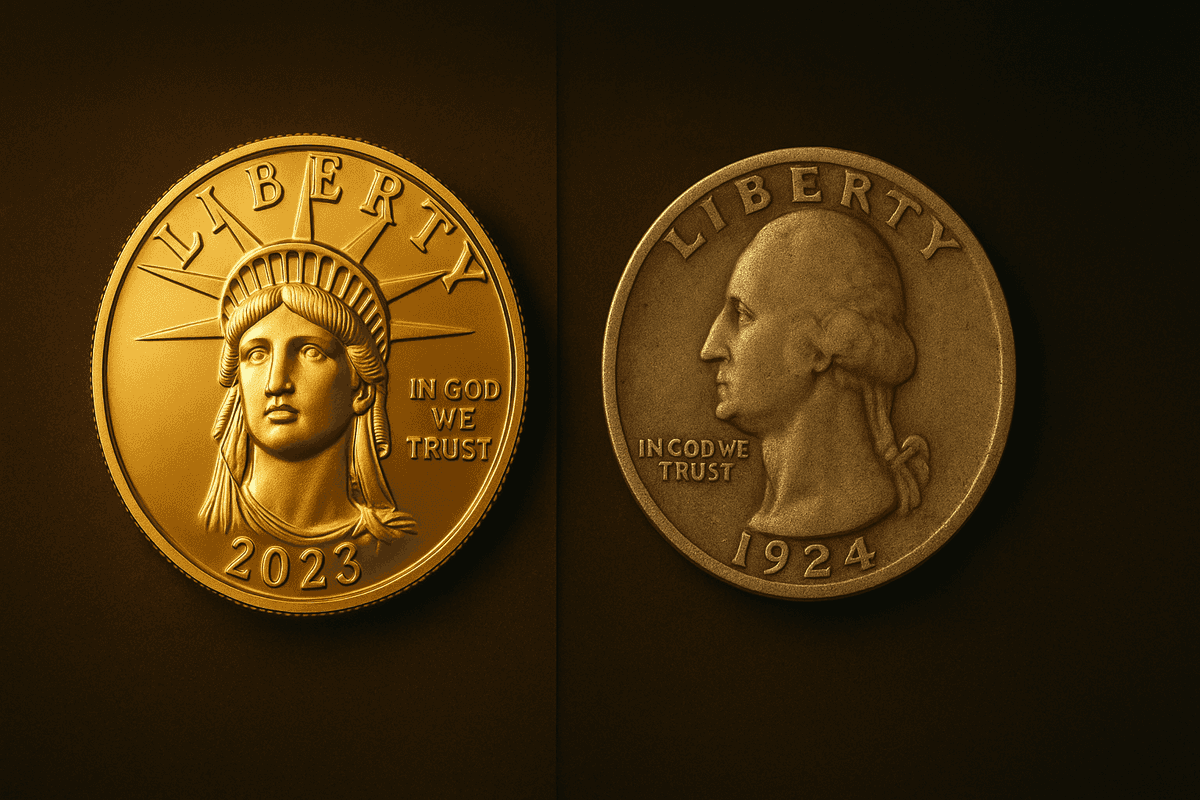
Two Coins, Two Very Different Kinds of "Rare"
This week the U.S. Mint sold Trump $1 coins with a special "JULY 4th" privy mark — 250,000 of them, randomly mixed into a production run of up to 8.75 million rolls and bags. Across the news, the word being used to describe them is "rare."
Now hold that next to a different number: 52,000. That is the mintage of the 1916 Standing Liberty quarter — a coin struck with no privy mark, no marketing campaign, and no "limited edition" designation, but with a scarcity that the market spent a century learning to respect. Nobody had to tell collectors the 1916 was rare. The surviving population told them.
These are two completely different things wearing the same word. One is scarcity by design — a deliberately limited number, decided by a committee, announced in a press release. The other is scarcity by history — a coin that is rare because time, circulation, and survival did their work. Both have value. Only one has proven value.
Why "Rare" Is Doing So Much Work
"Rare" is a powerful word in this hobby, and like all powerful words, it gets stretched. A 250,000-mintage privy-mark coin is not rare by any honest numismatic standard — the 1909-S VDB Lincoln cent, itself hardly a deep rarity, has a mintage of just 484,000 and most collectors would not call it rare. What the privy-mark coin has is novelty and scarcity relative to a much larger run — which is a real thing, but it is not the same as rarity, and conflating the two is where money gets left on the table.
Here is the uncomfortable part: manufactured rarity works — for a while. The privy-mark chase drives a wave of opening-day demand, flips on the secondary market, and a brief spike in prices. But the long-term value of a coin is determined by sustained collector demand and genuinely limited survival, not by the number printed on the box. The coins that hold value decade after decade are the ones where scarcity is a fact of history, not a marketing decision.
The Data Tells You Which Game You're Playing
This is not an argument against buying modern mint products. Plenty of them are beautiful, well-made, and legitimately collectible. It is an argument for pricing with your eyes open about why a coin costs what it costs.
When you look up a coin, ask yourself: is the value driven by the spot price, by a mintage number, or by a hundred years of auction data? A common Standing Liberty quarter in circulated condition tracks silver. A 1916 in Mint State tracks a century of scarcity. A brand-new privy-mark dollar tracks a release date and a press cycle. All three are real markets. They just require different pricing logic.
This is exactly what a confidence score is for. LastSoldCoin's FloorBid gives you a single dealer-buy number, and BidScore tells you — honestly — how much market data backs that number. A deep, liquid coin shows a high score. A thin-data rarity shows a lower one. And a brand-new release, with almost no sold-comps history yet, will show exactly how little verifiable data exists to support a premium. That is not a bug. It is the honest answer.
The Bottom Line
Buy the privy-mark coin because you like it. Buy the Palladium Eagle because the design moves you. Buy the 1916 quarter because the data says it is rare. Just do not let one word — "rare" — do the pricing for you. There is a difference between a coin the Mint tells you is scarce and a coin the market has spent a century proving is scarce.
Manufactured rarity is a fine reason to collect. It is a terrible reason to overpay. Know which game you are playing — and price with the data, not the press release.
Price with the data, not the hype
Search any US coin on LastSoldCoin. FloorBid gives you the dealer-buy number, BidScore tells you how much real market data is behind it. Always visible. Always honest.
Try LastSoldCoin →