
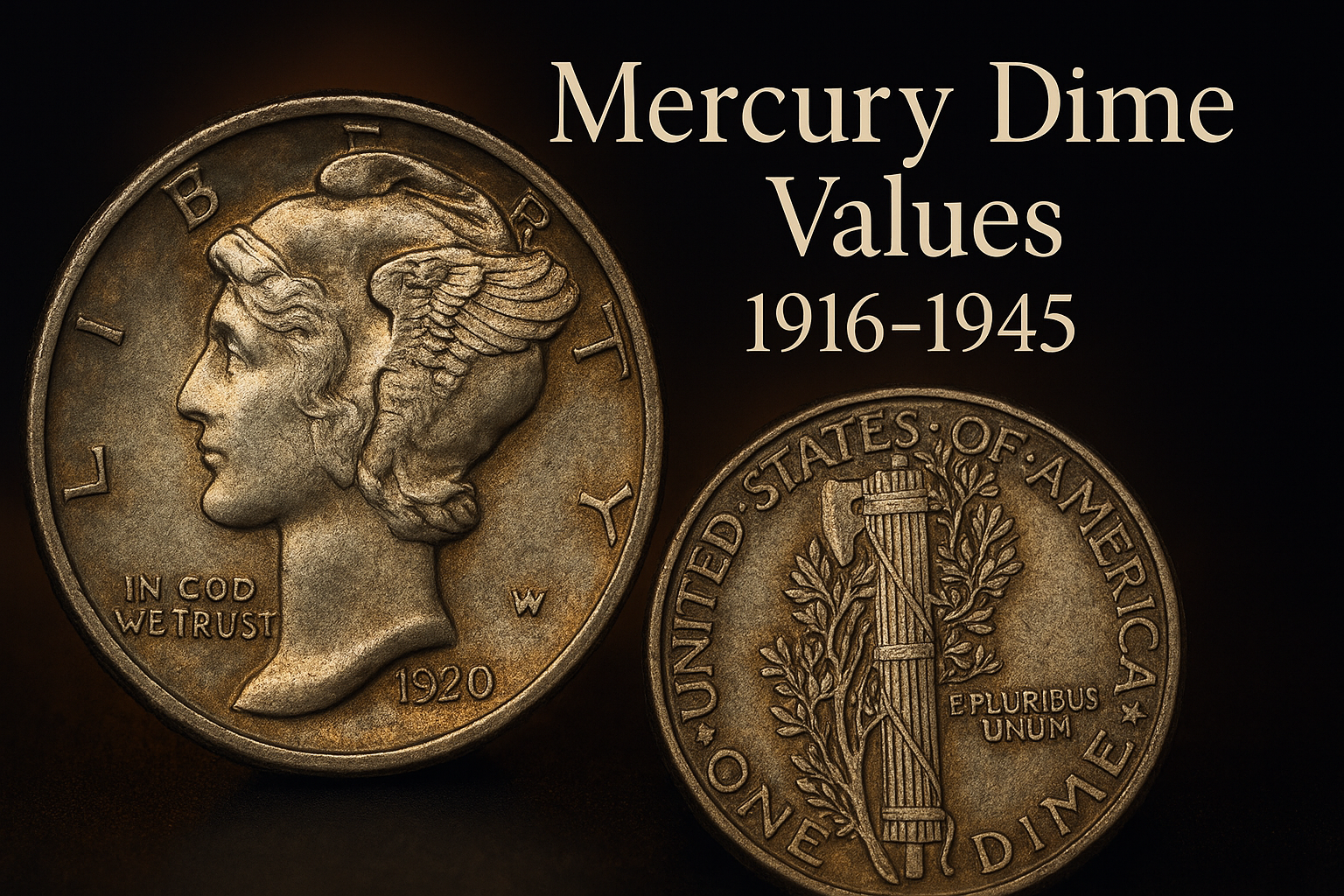
The Mercury dime — officially the Winged Liberty Head dime — is one of the most elegant designs ever to grace American coinage. Struck from 1916 to 1945, these 90% silver dimes carry the artistic legacy of sculptor Adolph A. Weinman and remain a cornerstone of 20th-century collecting. Whether you're hunting junk silver rolls on Whatnot or building a complete date-and-mint set, understanding Mercury dime values starts with two things: silver content and rarity.
What Makes Mercury Dimes Valuable: Silver Content and Melt Value
Every Mercury dime contains 0.0723 troy ounces of pure silver — 90% silver and 10% copper alloy, weighing 2.5 grams total. At spot silver prices of ~$63.57/oz (as of August 8, 2026), each Mercury dime carries a melt value of roughly $4.60. A $1 face value of 10 common-date Mercury dimes melts for approximately $45.96.
This melt-value floor means even the most common, heavily circulated 1940s Mercury dimes won't sell for less than a few dollars — and at today's elevated silver prices, the floor is higher than it's been in decades. If you're buying junk silver bags, Mercury dimes are trading at roughly the same melt multiples as Roosevelt dimes, though key and semi-key dates command substantial numismatic premiums above melt.
For live, spot-adjusted melt calculations during your stream, use LastSoldCoin to pull real-time pricing across eBay, Greysheet CPG, and sold comps in seconds.
The Mercury Dime Key Dates: Where the Real Money Lives
While the vast majority of Mercury dimes are worth a modest premium over melt, a handful of dates transform this series into one of the most exciting hunts in numismatics. The key dates fall into three tiers: the legendary low-mintage issues, the semi-keys that still command serious premiums, and the overdate varieties that keep even experienced dealers on their toes.
The Holy Grail: 1916-D
With a mintage of just 264,000 coins, the 1916-D Mercury dime is the undisputed king of the series. It's the lowest-mintage regular-issue dime of the 20th century and one of the most counterfeited coins in the hobby — always buy certified examples. In Good condition (G-4), a problem-free 1916-D trades in the low four figures. In Mint State, prices escalate dramatically: an MS-65 example with full split bands on the fasces reverse can bring five figures at auction. If you find an uncertified 1916-D in a junk silver roll, stop everything and get it authenticated.
The 1921 Scarcity: 1921 and 1921-D
The 1921 Philadelphia (1.23 million minted) and 1921-D (1.08 million) are the second-tier keys. Unlike the 1916-D, these are genuinely scarce rather than rare — but in higher grades they're exceptionally difficult to locate. The 1921-D in particular is tough above VF, and well-struck examples with full bands are genuinely rare. Both dates carry strong premiums in all grades, and demand consistently outstrips supply in the collector market.
The Overdates: 1942/1 and 1942/1-D
The 1942/1 overdate — where a 1941 die was repunched with a 1942 date, leaving a visible "1" beneath the "2" — is one of the most famous mint errors in American coinage. Both the Philadelphia and Denver mint versions exist, and both carry substantial premiums. The overdate is visible to the naked eye with good lighting: look for the ghost of a "1" peeking out from beneath the "2" in the date. Even circulated examples command strong premiums over common 1942 dimes.
Semi-Key Dates: The Sleepers Worth Watching
Beyond the headliners, several Mercury dime dates trade at meaningful premiums over common material. These semi-keys are the coins that experienced collectors quietly accumulate — they're findable with patience, but they'll never be cheap:
- 1926-S — Low mintage (1.52 million), scarce in all grades. A key date in the San Francisco run.
- 1931-D — Only 1.26 million struck. The Great Depression meant few were saved in high grade.
- 1931-S — 1.8 million minted. Another Depression-era survivor with genuine scarcity above XF.
- 1925-D — 5.1 million minted but poorly struck. Finding one with strong detail is a challenge.
- 1927-D — 4.8 million. Underrated and increasingly difficult in problem-free condition.
Full Split Bands: Why Strike Quality Changes Everything
On the Mercury dime reverse, the fasces — a bundle of rods bound with horizontal bands — is the diagnostic feature that separates average coins from exceptional ones. A "Full Split Bands" (FSB) or "Full Bands" (FB) designation means the central horizontal bands on the fasces show complete separation with no merging or flatness. This is the Mercury dime equivalent of a Full Bell Lines Franklin half or a Full Head Standing Liberty quarter.
The premium for FSB designation varies dramatically by date. Common 1940s Mercury dimes with full bands might only command a modest bump over non-FSB examples — but for key and semi-key dates, the FSB designation can multiply the price several times over. The 1916-D, 1921, and 1921-D in particular see massive FSB premiums because well-struck examples of these dates are exceptionally rare. If you're grading Mercury dimes for your collection, always check the bands before you price the coin.
Common Date Mercury Dime Values (1940–1945)
The Philadelphia-minted Mercury dimes from the 1940s are among the most common coins in the series — high mintages, widely saved, and readily available in all grades. These are the coins you'll find most often in junk silver rolls and dealer bargain bins.
⚠️ Market note (August 2026): With spot silver at ~$63.57/oz, Mercury dime melt value is ~$4.60. Prices below represent typical retail ranges; dealers and auction results may vary. For live sold comps during your stream, use LastSoldCoin.
| Date / Mint | Good | VF | XF | AU | MS-63 |
|---|---|---|---|---|---|
| 1940 | $5–7 | $7–10 | $12–18 | $20–30 | $40–60 |
| 1941 | $5–7 | $7–10 | $12–18 | $20–30 | $40–60 |
| 1942 | $5–7 | $7–10 | $12–18 | $20–30 | $40–60 |
| 1943 | $5–7 | $7–10 | $12–18 | $20–30 | $40–60 |
| 1944 | $5–7 | $7–10 | $12–18 | $20–30 | $40–60 |
| 1945 | $5–7 | $7–10 | $12–18 | $20–30 | $40–60 |
Values are approximate retail ranges. The $5 floor reflects current silver melt of ~$4.60 plus a modest numismatic premium. Always check sold comps for your specific coin's grade and eye appeal.
Mercury Dimes on Whatnot: Why Streamers Love This Series
Mercury dimes are a staple of live coin selling for good reason. They're affordable enough to run as "dollar starts" and flash sales, recognizable enough that viewers don't need a lengthy education before bidding, and the key-date lottery keeps every roll break exciting. A bag of mixed 1940s Mercury dimes at $5–7 a coin moves fast on stream — and if a 1916-D or 1942/1 overdate surfaces, the clip goes viral.
For streamers pricing Mercury dimes on the fly: the melt-value floor is your friend. At ~$4.60 per dime in silver content, you have a hard floor that protects your downside on every common-date coin you sell. The numismatic premium above melt is where your margin lives — and that premium is entirely driven by date, grade, and strike quality. Having a pricing tool that can pull eBay sold comps, Greysheet CPG, and active listings in one search is the difference between guessing and knowing.
Ready to price Mercury dimes with confidence on your next stream? Try LastSoldCoin — instant pricing across eBay, Greysheet, and sold comps, built for live sellers.
Building a Mercury Dime Collection: Three Strategy Tiers
There are three classic approaches to collecting Mercury dimes, each with its own budget and complexity level:
- The Date-and-Mint Set (77 coins). Every date and mint mark combination from 1916 to 1945. This is the full challenge — 77 coins covering Philadelphia, Denver, and San Francisco. Budget several years and a five-figure allocation. The 1916-D alone will be your biggest hurdle.
- The Short Set (1940–1945). A 15-coin subset covering the wartime years. All dates are common, the total cost is manageable (under $200 in circulated grades), and it's a complete, satisfying collection you can build in a weekend. Perfect for new collectors and young numismatists.
- The Type-Only Approach. One high-grade example of a Mercury dime — typically an MS-65 or better common date with full split bands. Costs $100–200 for a stunning coin, and you own a piece of Adolph Weinman's artistic legacy in gem condition. Zero stress, maximum beauty.
How to Grade a Mercury Dime: What to Look For
Mercury dime grading rewards attention to a few specific wear points. On the obverse, check the wing feathers above Liberty's ear — these are the high point and wear first. The hair detail over the forehead and the fine lines in the winged cap are the next to go. On the reverse, the fasces bands are everything: the central horizontal bands should show clear separation, and the vertical rods should retain individual definition.
Circulated grades (G–VF) show progressive wear on Liberty's wing and the fasces bands. XF examples retain most detail but show light wear on the highest points. AU coins look Mint State at a glance but reveal friction on the wing tip or cheek under magnification. True Mint State Mercury dimes are a joy — the satiny silver luster on an uncirculated 1940s example is one of the best values in American numismatics.
Why Mercury Dimes Belong in Every Collection
The Mercury dime series has it all: a world-class design, a manageable 77-coin set, genuine key-date rarities that reward the hunt, and a silver-content floor that protects your investment. Few coin series offer such a wide range of collecting strategies — from the $200 short set to the five-figure complete collection — while maintaining the same beautiful canvas.
As of August 8, 2026, with silver at ~$63.57/oz, every Mercury dime carries a melt value of roughly $4.60. That floor means even your most common filler coins retain real intrinsic value. The numismatic premium above melt is where the collecting story lives — and it's a story worth telling.