
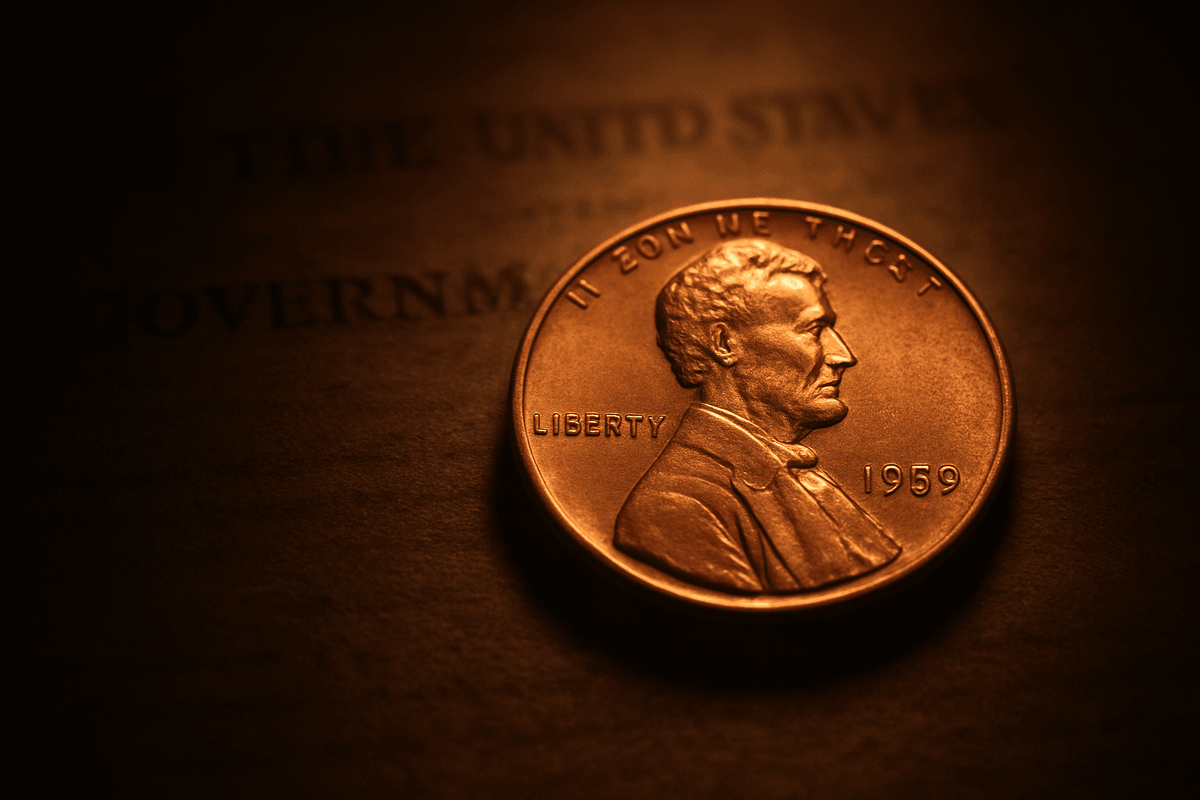
The Headline: The Common Cents Act Clears the House
The penny moved a step closer to becoming history this month. Numismatic News reported (September 15, 2026) that the U.S. House of Representatives has passed the Common Cents Act, legislation that would permanently end circulating-cent production and establish nationwide cash-rounding rules.
Crucially for collectors, the bill preserves the penny as legal tender and as a collectible. It does not make your cents worthless, and it does not pull them from circulation overnight — existing pennies would simply remain in use and be rounded away at the register over time. But it does signal something real: the coin that has been minted continuously since the Lincoln cent debuted in 1909 is likely nearing the end of its run as a circulating denomination.
To be clear about where this stands: the House has passed it. It still has to clear the Senate and the president's desk before it becomes law. That's a meaningful distinction, and it's why we're framing this as "closer to history" rather than "gone." But the direction of travel is hard to miss.
Why the Penny Story Matters to Coin People
Here's the part that matters for anyone who buys and sells coins rather than just spends them. The end of circulating cent production doesn't change the value of the key dates in your album — an 1877 Indian Head cent or a 1909-S VDB Lincoln cent was never priced by how many pennies are in the cash drawer. But it does sharpen a theme we've been writing about all season: the gap between "common" and "collectible" is about history, condition, and demand — not about whether a coin is still being made.
A modern zinc cent is common because billions exist. A 1909-S VDB wheat cent is scarce because only 484,000 were struck and far fewer survive in high grade. The Common Cents Act doesn't change that math — it just reminds people to finally look at the cents they've been ignoring.
Hot Market, Hot Fakes: 2026 Quarters Draw Counterfeits
When demand soars, counterfeits follow — and that's exactly what Numismatic News reported (September 11, 2026) about America's 250th-anniversary coinage. Counterfeit and altered Semiquincentennial quarters are beginning to surface online as enthusiasm for the new designs heats up.
This is a predictable pattern, and it's worth taking seriously even if you only deal in "ordinary" coins. The same channels that move a fake 2026 quarter will happily move an altered key date or a counterfeit Morgan dollar. The lesson isn't "avoid new coins" — it's "verify before you buy, and buy from sources you can hold accountable." Authentication tells you a coin is genuine; it does not tell you what it's worth. Those remain two different questions.
On the Block: Stephen Album's Auction 56
On the world-coin side, Stephen Album Rare Coins' Auction 56 (September 17–20) put 3,450 lots on the block, headlined by major collections of Cap & Rays 8 reales and Chinese coins, plus rare Ancient, Islamic, and Indian issues (Numismatic News, September 16, 2026). It's a reminder that the market is broader than U.S. type coins — and that world rarities have their own deep, competitive collector base.
Spot Metals: Gold and Silver Climb Back
At the time of writing (September 21, 2026), gold traded at roughly $4,345.30 per troy ounce and silver at $66.44 per troy ounce — a climb back from the mid-September pullback we flagged a week ago.
At $66.44 silver, the 90% coinage melt math works out to roughly $51.39 per Morgan or Peace dollar (0.77344 oz), $24.03 per half dollar (0.36169 oz), $12.02 per quarter (0.18084 oz), and $4.81 per dime (0.07234 oz). At $4,345.30 gold, a $20 Saint-Gaudens double eagle carries roughly $4,204 in melt (0.9675 oz of gold).
The melt floor matters most on 90% silver and gold coins. For base-metal cents — copper and copper-nickel — the metal is worth almost nothing, which means their value is entirely about rarity, grade, and demand. That's a distinction worth keeping straight as the penny headlines roll in.
What This Means for Streamers and Dealers
Three takeaways. First, the penny story is a conversation starter, not a pricing event. Use it to get buyers thinking about the cents they've stashed away — then price those cents on real comps, not nostalgia.
Second, treat the fake-2026-quarter story as a standing reminder to verify. In a hot market, the seller who can show their work — the comps, the confidence, the reasoning — is the one buyers trust, and trust is the thing counterfeits can't fake.
Third, watch the metal. Gold and silver are climbing again, and every up-move changes the melt floor under your 90% and bullion inventory. If you're pricing from a number you memorized a week ago, you're already behind.
Price every coin on its own data
Search any US coin on LastSoldCoin. FloorBid gives you the dealer-buy number, BidScore tells you how confident it is — from deep-comp common coins to thin-air keys. Always visible. Always honest.
Search a Coin →