
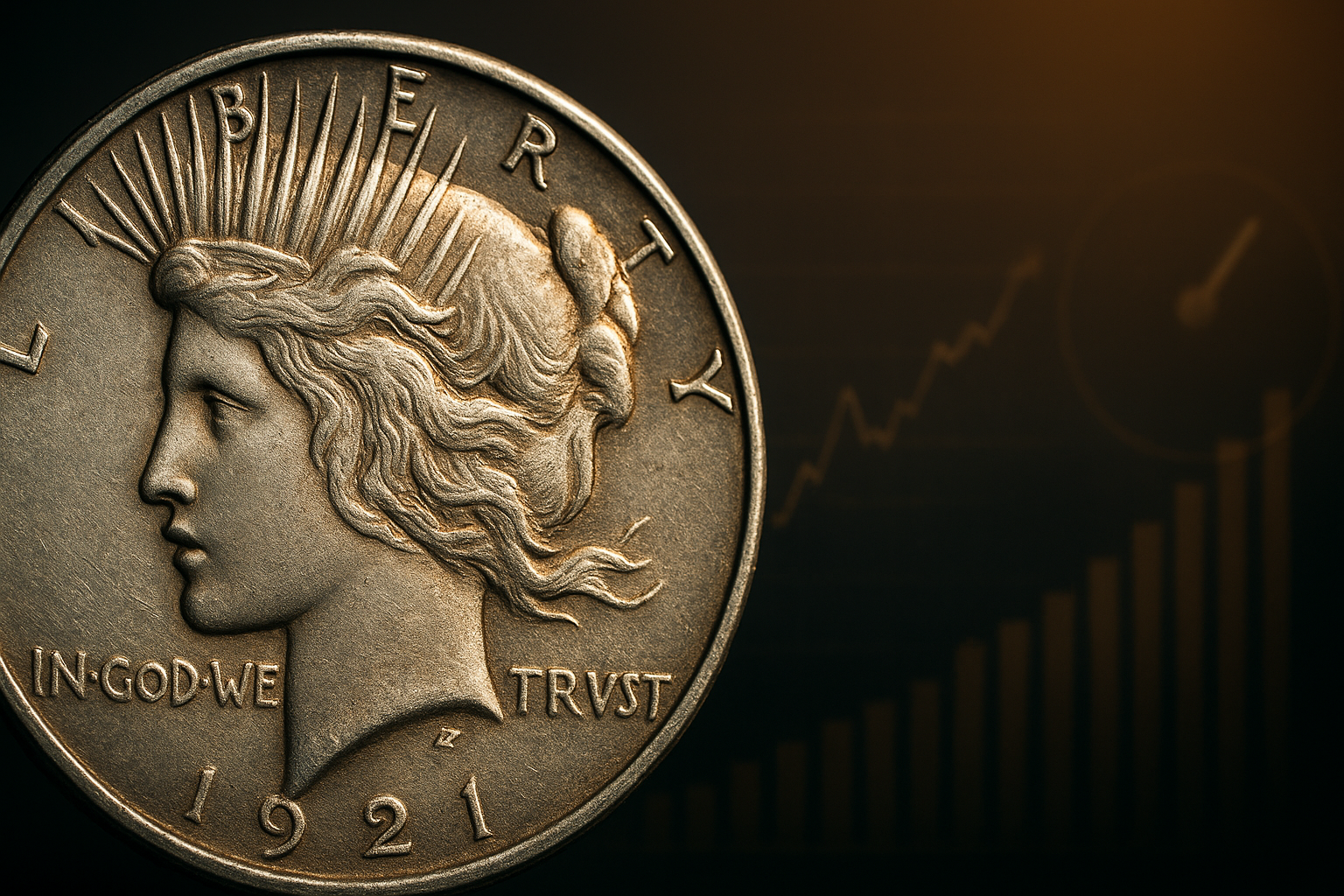
A Silver Dollar Born from the End of War
The Peace dollar was America's commemoration of the end of World War I. Anthony de Francisci's design — Lady Liberty in a radiant crown on the obverse, a perched eagle clutching an olive branch on the reverse — replaced the Morgan dollar in 1921 and ran through 1935. It was, at the time, a statement coin: a symbol of peace after the war that was supposed to end all wars.
Today it is a workhorse of the silver market. With 90% silver content (0.77344 troy ounces per coin), Peace dollars have a real melt floor that anchors every common date — and a handful of genuinely scarce dates where the numismatic premium takes over entirely. Understanding where a given coin sits on that spectrum is the whole game.
The Melt Floor (September 2026)
With silver trading around $66.20 per troy ounce (as of September 7, 2026), every Peace dollar carries roughly $51.20 in melt value — 0.77344 ounces of silver at spot. Common circulated dates (1922, 1923, 1924, 1925, and the mid-1930s Philadelphia and Denver issues) trade at modest premiums above that floor, typically a few dollars in lower grades, because they exist in enormous quantities.
That floor is structural right now. Silver has added more than $10 per ounce since early 2026, and the entire 90% silver dollar market has recalibrated upward. When spot moves, common Peace dollars move almost in lockstep. When spot is flat, they sit flat. For these coins, pricing is simple: melt plus a thin premium, and move volume.
The Key Dates: Where Melt Stops Mattering
Two dates in the Peace dollar series behave completely differently — and they are the ones that test pricing tools.
- 1921 Peace dollar (mintage 1,006,473). The high-relief first-year issue. Struck with the same deep relief as the 1921 Morgan's companion, it wears quickly, so well-struck, high-grade examples are scarce relative to the mintage. Circulated examples carry a healthy premium over common dates; Mint State examples are the real prize, and genuinely choice gems are thin on the ground.
- 1928-P Peace dollar (mintage 360,649). The undisputed key to the series. Philadelphia struck just over 360,000 coins in 1928 — a fraction of the millions produced in other years — and the date was heavily saved but also heavily circulated. High-grade 1928-P dollars are scarce; in MS-65 and above, they command prices that have nothing to do with silver content.
This is where thin-data pricing rears its head. A 1928-P in MS-65 might have a handful of auction records in a year, not hundreds. A 1921 in high relief, well struck, is rarer than its mintage suggests and generates wide price spreads between auction houses. Quoting a single "value" for these coins without acknowledging how much data backs it is how sellers get burned.
How to Price a Peace Dollar Honestly on Stream
The workflow is the same one that works for every silver series, but Peace dollars reward it especially well because of the stark common-vs-key split.
- Read the date and mint mark (5 seconds). The date is on the obverse below Liberty. The mint mark — if any — is on the reverse, below the word "ONE," on the eagle's perch. No mint mark means Philadelphia, which for 1928 is the key. For most other years, S and D are the common branch mints.
- Call the condition (5 seconds). Peace dollars wear first on Liberty's cheek, the hair above her forehead, and the eagle's wing feathers. A Good (G4) coin has a flat but complete rim and worn central detail; Very Fine (VF20) shows clear design with moderate wear; About Uncirculated (AU50) shows only the slightest friction on the high points. Be honest — grade drives price, and Peace dollars are notoriously tricky at the AU/MS boundary.
- Pull the FloorBid and BidScore (5 seconds).Search the coin on LastSoldCoin. The FloorBid number is your dealer-buy estimate. The BidScore tells you how much data is behind it. A common 1923-P in AU50 will show a high BidScore — deep, liquid comps, tight spreads. A 1928-P in MS-65 will show a lower score — real data, but sparse, with wider spreads. That distinction is the entire point.
- Set the price (5 seconds). For common dates: melt plus a small premium, move fast, sell volume. For 1921 high-relief and 1928-P: let the BidScore guide your margin. A high score means confidence to price aggressively; a lower score means widen your spread and disclose the thinner data to your buyer.
The Honest-Pricing Lesson in the Peace Dollar Series
The Peace dollar is a perfect teaching series because it forces you to answer one question before you name any price: am I pricing a commodity or a collectible? A 1923-P Peace dollar in circulated condition is a commodity — its value is silver plus a sliver of premium, and it will trade in a tight band. A 1928-P in high Mint State is a collectible — its value is scarcity, condition rarity, and collector demand, and it will trade in a wide band with far fewer data points.
Confusing the two is the most common pricing error in silver coin selling — quoting a commodity price on a collectible, or worse, a collectible price on a commodity. That is exactly what FloorBid and BidScore exist to prevent. The number gives you the dealer-buy estimate. The score tells you which of the two games you are actually playing.
Price any Peace dollar in seconds
Search a 1923-P or a 1928-P on LastSoldCoin. FloorBid gives you the dealer-buy number, BidScore tells you how much data is behind it — from deep common-date comps to thin-air keys. Always visible. Always honest.
Search a Peace Dollar →