
A Design Built on Symbolism — and a Famous Flaw
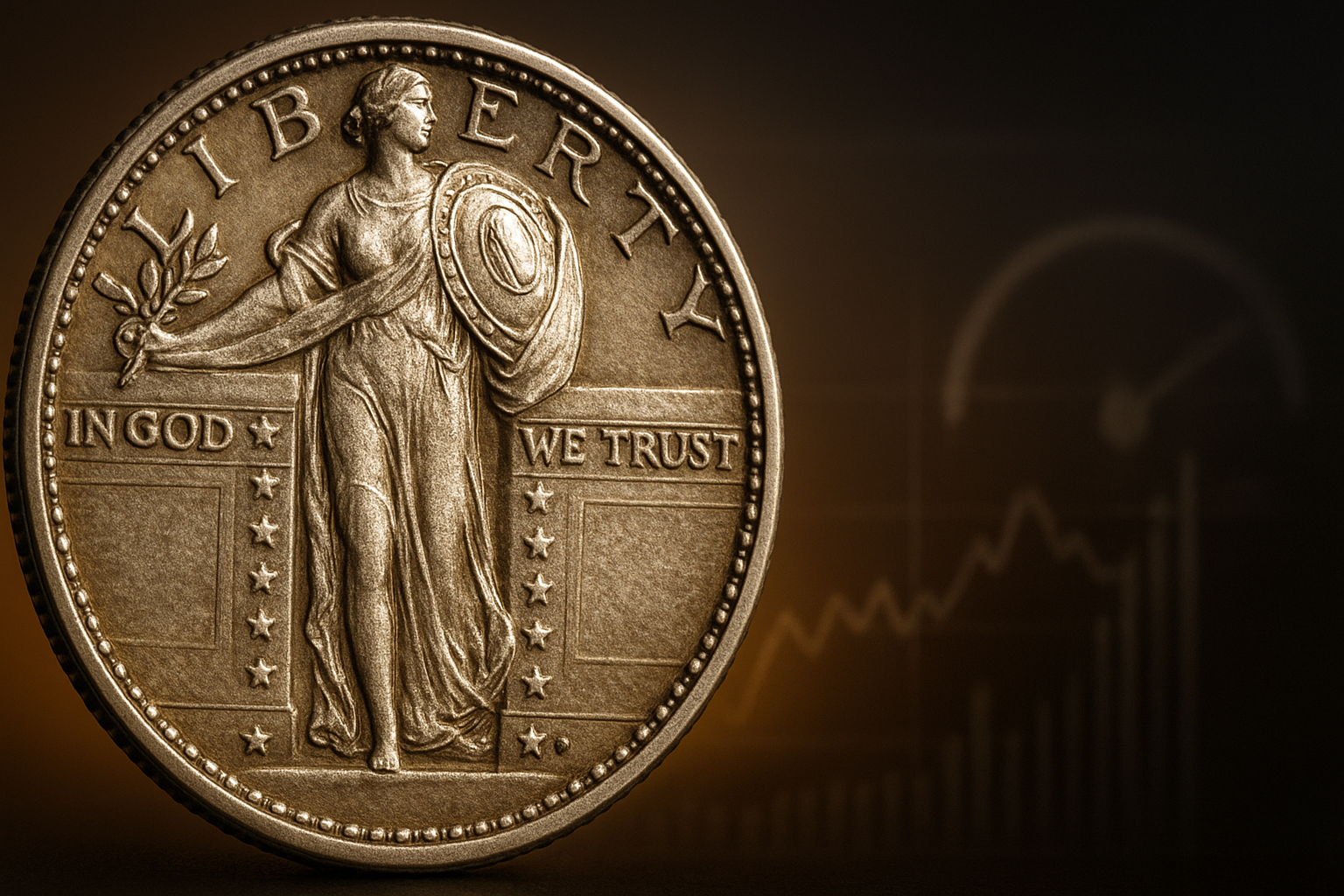
Hermon A. MacNeil's Standing Liberty quarter, struck from 1916 through 1930, is often called the most artistic coin the U.S. ever put into circulation. The obverse shows Liberty standing between two pedestals, holding an olive branch and a shield, with a rising sun behind her; the reverse carries an eagle in flight.
It also contains one of the most consequential design flaws in coinage history. On the original Type 1 design (1916–1917), the date sits raised at the base of the coin — and because it is one of the highest points on the surface, it wore away quickly. By the late 1920s, millions of circulating quarters had no readable date at all. This single flaw reshaped the entire series: it shortened the effective lifespan of the design, created the famous 1918/7-S overdate (where the dies were altered to salvage dated dies), and to this day makes "Full Date" a premium condition that collectors pay up for.
Type 1 vs. Type 2: The Design Change That Splits the Series
In 1917, the Mint redesigned the coin to fix the date-wear problem and quiet a public outcry over the original design. The result is two distinct types:
- Type 1 (1916–1917): Liberty's right breast is bare, and the date is raised. These are the scarcer, more desirable early issues — and the 1916 is the key to the entire series.
- Type 2 (1917–1930): Liberty wears a chainmail tunic, and the date is recessed so it no longer wore away. These make up the vast majority of the series.
That Type 1/Type 2 split matters enormously for pricing. A 1917 Type 1 quarter is a fundamentally different coin from a 1917 Type 2, and confusing them — or selling a Type 1 at a Type 2 price — is one of the most common errors in the series. If you cannot tell them apart at a glance, you should not be quoting a price from memory.
The 1916: The Key Date in Thin-Data Territory
The 1916 Standing Liberty quarter has a mintage of just 52,000 — the lowest of the series by an order of magnitude, and one of the most famous key dates in all of 20th-century U.S. coinage. Because the design debuted so late in the year, the first Philadelphia run was tiny, and virtually all of them entered circulation hard.
That scarcity creates a genuine thin-data problem at the high end. There are plenty of low-grade examples floating around in AG–Good condition, where the market is reasonably liquid. But as you climb into Very Fine and above — and especially into Mint State — the population of problem-free, attractive coins collapses, and the auction record count per year drops into the single digits for the finest pieces. A 1916 in MS-63 might see only a handful of verifiable sales in a given year, and the spread between them can be wide.
This is where a confidence score earns its place. When the data is deep, you can price aggressively. When it is thin — as it is for a choice 1916 — you need to know that before you commit capital or quote a buyer a hard number.
The Rest of the Key and Semi-Key Dates
- 1918/7-S overdate. The most famous variety in the series — an 8 punched over a 7 on the 1918-S die. Collectors prize it, and it commands a substantial premium in all grades, though it is widely counterfeited and frequently misattributed.
- 1921 (1,916,000 mintage). A one-year-only recession issue with no mint mark, produced during the post-World War I economic slump. Lower mintage than most of the 1920s dates and genuinely scarce in higher grades.
- 1923-S (1,360,000 mintage). The rarest regular-issue coin of the later 1920s. Well-struck examples with full heads are especially tough and carry a real premium.
A note on "Full Head" (FH): on Standing Liberty quarters, the FH designation — awarded when Liberty's head shows complete detail — is the series' defining condition metric. A common 1920s date in MS-63 is one coin; the same coin with FH certification is a materially rarer and pricier one. Do not assume an uncertified "uncirculated" coin has a full head. Most do not.
Silver Melt Context (September 2026)
Standing Liberty quarters are 90% silver (0.18084 troy ounces each). At $65.82 per troy ounce (September 7, 2026), every quarter in the series carries roughly $11.90 in melt value. Common circulated 1920s dates — the bread and butter of the series — trade at modest premiums above that floor, typically a few dollars in Good to Very Fine.
But here is the crucial point: for the keys, melt is irrelevant. A 1916 in Good condition is worth a multiple of its silver content, not a fraction above it. The moment you start pricing a key date off the spot chart, you are making the single most expensive error in the series. The numismatic premium swamps the metal value by a wide margin, and it is driven by scarcity and condition — not by where silver is trading this week.
How to Price a Standing Liberty Quarter Honestly on Stream
- Read the date (or its absence). If the date is worn off, you are almost certainly holding a circulated Type 1 — and the value drops sharply. If the date is clear, move on to type and grade. A readable date is itself a premium.
- Identify Type 1 vs. Type 2 (5 seconds). Bare breast = Type 1 (1916–1917). Chainmail = Type 2 (1917–1930). This one detail changes the coin's entire market.
- Check the condition — and the head (5 seconds).Standing Liberty quarters wear first on Liberty's head, her right leg, and the shield. A "Full Head" coin is worth dramatically more. Be honest: the FH distinction is where uncertified sellers lose the most money.
- Pull the FloorBid and BidScore (5 seconds).Search the coin on LastSoldCoin. The FloorBid number is your dealer-buy estimate; the BidScore tells you how much data is behind it. A common 1929-P in VF shows a high BidScore — deep, liquid comps. A 1916 in AU50 or better shows a lower one — real data, but sparse. Price accordingly.
- Set the price (5 seconds). Common dates: melt-plus-premium, move fast, sell volume. Key and semi-key dates: let the BidScore guide your margin — high score means confidence to price aggressively, low score means widen the spread and disclose the thinner data.
The Honest-Pricing Lesson in the Standing Liberty Series
The Standing Liberty quarter is the rare series that teaches you three pricing lessons at once. First: condition is not the same as grade — a "full head" is a separate dimension of scarcity that the casual eye misses. Second: a readable date is a feature, not a given. Third: the key date lives in thin-data territory, where a confidence score matters more than a single number.
That is the entire value proposition behind FloorBid and BidScore. One number for the dealer-buy price. One score for how much market data is actually behind it. When you can tell a buyer "the FloorBid on this 1923-S in AU is $X and the BidScore is 61 — meaning the comps are real but the population is thin," you are not just quoting a price. You are showing your work. And that closes sales.
Price any Standing Liberty quarter in seconds
Search a 1916 or a 1923-S on LastSoldCoin. FloorBid gives you the dealer-buy number, BidScore tells you how much data is behind it — from deep common-date comps to thin-air keys. Always visible. Always honest.
Search a Standing Liberty Quarter →