
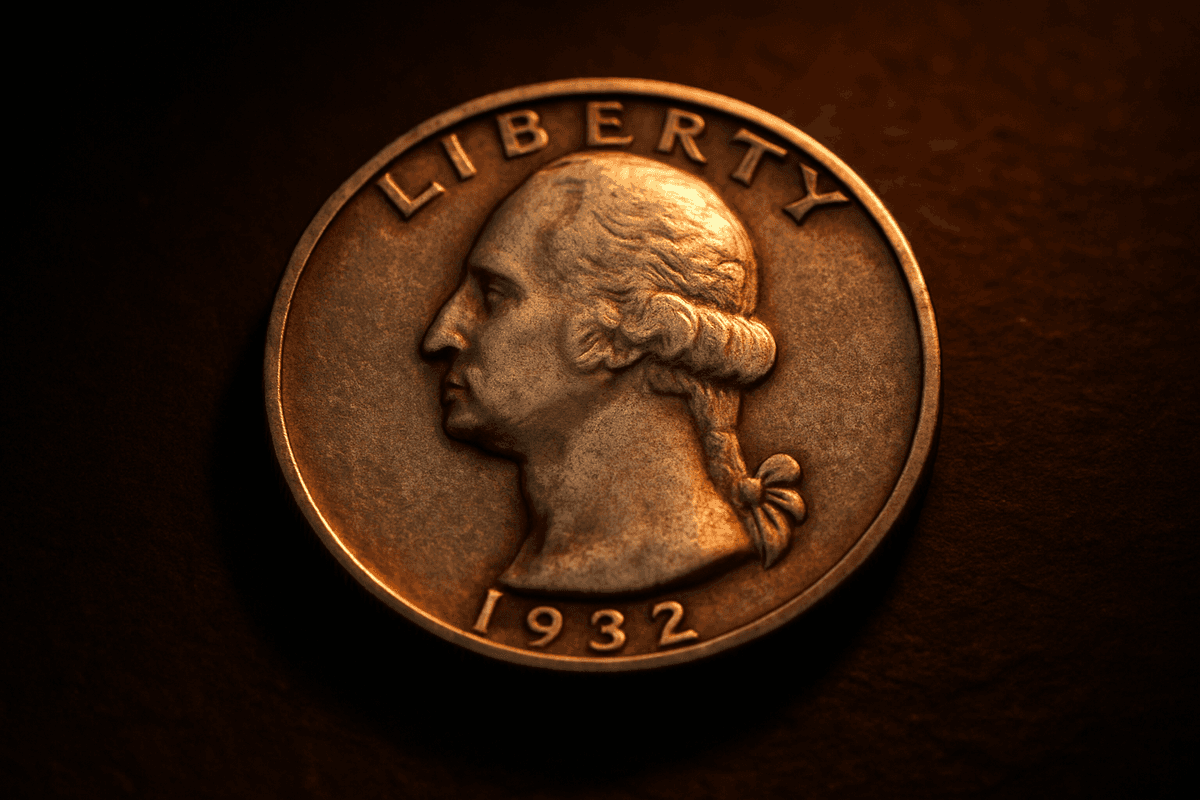
A Commemorative That Refused to Go Away
The Washington quarter, designed by sculptor John Flanagan, was first struck in 1932 to mark the bicentennial of George Washington's birth. It was meant to be a one-year commemorative — but the public liked it so much that the Mint made it the permanent replacement for the Standing Liberty quarter, and it has anchored the denomination ever since.
That origin matters for pricing, because the very first year is where the series' famous keys live. The 1932-Dand 1932-S quarters, struck at Denver and San Francisco, had the smallest mintages of the series and have been chased by collectors for decades. If you find a 1932 quarter with a D or S mint mark on the reverse, you're looking at the series' headline coins.
The Silver-to-Clad Divide: The Line That Sets the Floor
The single most important fact about Washington quarters is the 1965 transition. Quarters struck from 1932 through 1964 are 90% silver — 0.18084 troy ounces per coin. Quarters struck from 1965 onward are copper-nickel clad, with no meaningful metal value.
That line creates a floor for the silver dates. A common-date pre-1965 quarter will always carry a melt value tied to the price of silver, regardless of its condition. A post-1965 clad quarter has no such floor — its value comes entirely from rarity and collector demand, and most circulated clad Washington quarters are worth face value.
This is why it's worth checking the date before you price a quarter. Two coins that look nearly identical — a 1964 and a 1965 — sit on opposite sides of a real value divide. One has a metal floor under it; the other doesn't.
The Keys and the Famous Variety
Beyond the 1932-D and 1932-S, the series has one variety that collectors know by name: the 1934 doubled die obverse, where the date and lettering show a visible doubling. It's a classic example of how a minting error can turn an otherwise ordinary date into a sought-after coin.
Then there's the Bicentennial quarter, dual-dated 1776–1976 with the drummer-boy reverse. Millions were saved, so most circulated examples are worth only face value — but it's a favorite first coin and a good reminder that "special" doesn't always mean "scarce." The real keys of the series are the low-mintage 1932 dates, not the ones that were hoarded by the roll.
These are precisely the coins where a confidence score earns its keep. A common-date silver quarter has a thick, liquid market and lots of comps; a 1932-D or 1932-S in a high grade does not. When the data thins out, the honest move is to say so — and to price with the uncertainty you actually have.
How to Value a Washington Quarter Honestly
Start with the date and mint mark. The mint mark sits on the reverse, below the wreath (on pre-1965 issues), and it's the difference between a common coin and a key date. Then check which side of 1965 you're on — that tells you whether you have a metal floor or not.
Finally, judge condition realistically. Washington quarters are a familiar coin, and wear shows up in the same places every time: Washington's hair, the eagle's breast feathers, and the high points of the wreath. The honest price always comes back to actual comparable sales for the exact date, mint mark, and grade in front of you — not a memorized number.
That's the whole point of showing your work. A dealer-buy number gives you a floor you can defend, and a confidence score tells you — and your buyer — how much real market data backs it. On a series where one year separates melt from key, showing that work is how you know what you actually have.
Price your quarters with real comps
Search any Washington quarter on LastSoldCoin. FloorBid gives you the dealer-buy number, BidScore tells you how confident it is — from common-date silver to the 1932-D and 1932-S keys.
Search a Coin →