
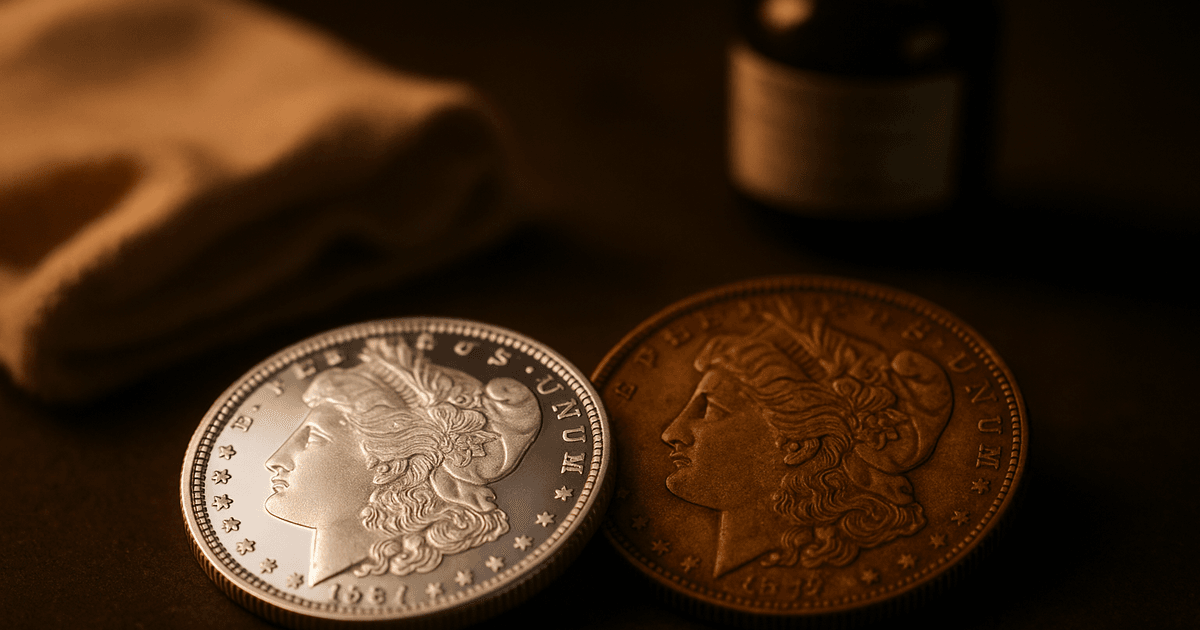
The Instinct Is Backwards
Somebody finds a tarnished silver dollar in a drawer. It looks dirty. They reach for silver polish, or toothpaste, or a “gentle” dip, and twenty minutes later they have a bright, shiny coin. It feels like they fixed something.
What they actually did was strip off the surface the market values and replace it with one it discounts. That is not a controversial opinion in numismatics — it’s the consensus, across every grading service, every major auction house, and every dealer who has ever had to explain a details grade to a disappointed owner. Original surfaces are the product. Cleaning is the destruction of the product.
What Cleaning Actually Does
“Cleaning” covers a lot of methods, and they all do versions of the same thing:
- Abrasive polish or paste removes a microscopic layer of metal along with the toning. It also leaves fine parallel scratches — hairlines — that catch light at an angle and never go away.
- Silver dip and other acid products dissolve tarnish chemically. They also leave residue that settles into the protected areas around letters and rims, which is why dipped coins so often look dark-outlined and unnaturally white at the same time.
- Whizzing — a wire brush or buffing wheel — leaves visible swirl marks and rounds off detail. It is the most destructive common method and the easiest to spot.
- Soap, water, and a “soft” cloth is the most forgivable version, and it still rubs the luster off a coin that had any.
The common thread: every one of these changes the surface. On a coin whose value is partly a function of how original that surface is, that is a value transfer from you to nobody.
Why the Market Punishes It
Grading services handle this bluntly. A cleaned coin generally doesn’t get a straight numeric grade at all — it gets a details or “improperly cleaned” designation, meaning the coin is authentic and the damage is disclosed. That coin is then a different market from the same coin with original surfaces. It doesn’t trade at a small haircut; it trades in a separate, thinner market, often well below a problem-free example of comparable detail.
We’re not going to print a percentage, because the discount varies enormously by series, rarity, and how obvious the cleaning is — a lightly wiped key date and an aggressively polished common date are not the same situation. But the direction is consistent: cleaning never adds value, and it can remove a large share of it. On a coin worth a few dollars, that costs you dollars. On a coin worth a few hundred, it costs you hundreds.
How to Spot a Cleaned Coin
You don’t need a loupe to catch most of these, just a lamp and a slow tilt of the coin:
- Too white, too even. Original silver has warm, uneven character. A coin that is uniformly bright white across every field and every protected area has usually been dipped.
- Hairlines in the fields. Tilt the coin under a single light. Fine parallel lines that run the same direction are wipe or polish marks, not mint luster.
- No cartwheel. Mint luster breaks light into a rolling, spinning effect as you tilt the coin. A dead, flat reflection means the surface is gone.
- Dark outlines. Toning or residue clinging in the crevices around lettering and stars while the fields are bright is classic dip residue.
- Copper that’s the wrong color. On copper, a harsh pink-orange glow or bright red with dark recesses is a warning sign. Original copper is brown, or a red that fades naturally rather than sitting flat.
- Wear and brightness that don’t match. A coin with obvious circulation wear should not look freshly struck. When those two stories conflict, believe the wear.
The One Legitimate Exception
Professional conservation exists, and it is not the same thing as cleaning. The grading services offer it, it’s done by people who stabilize and remove harmful surface contaminants without altering the coin’s original surface, and it’s reserved for coins where the intervention is genuinely appropriate. It is also expensive relative to the value of most coins.
The honest rule for anyone at home: if the coin is worth enough to matter, it’s worth asking a professional before you touch it. If it isn’t worth that call, it isn’t worth the polish either. There is no household product that improves a collectible US coin.
Pricing a Cleaned Coin Honestly
When a cleaned coin comes across your table or your stream, the mistake is pricing it as the coin it used to be. Price it as what it is: a problem coin, at a problem-coin level. Pull comps for cleaned or details-graded examples of that date and grade — they exist, and they are the only comps that apply.
This is where showing your work pays for itself twice. If you’re the seller, a dealer-buy number gives you a defensible floor instead of a hopeful one. If you’re the buyer, run the asking price against the real comps before you bid — a buy-check gives you a confidence read on whether that price is fair, and it shows you the reasoning rather than hiding it behind a verdict.
And say it out loud on stream. “This one has been cleaned — you can see the hairlines in the field — so it’s priced as a cleaned coin.” Buyers reward that. The people who get burned are the ones who didn’t know, and the sellers who didn’t tell them.
The Bottom Line
Cleaning a coin is the only common mistake in this hobby that destroys value instantly, permanently, and invisibly to the person doing it. Nobody polishes a coin out of malice — they do it because shiny feels like better, and the market says the opposite. Original surfaces, honest descriptions, and real comps are the whole game. Leave the polish in the drawer.
📖 Related Reads
Know what a problem coin is really worth
Search any US coin on LastSoldCoin. FloorBid gives you the dealer-buy number, BidScore tells you how confident it is — and both are always on screen, cleaned coin or not.
Search a Coin →