
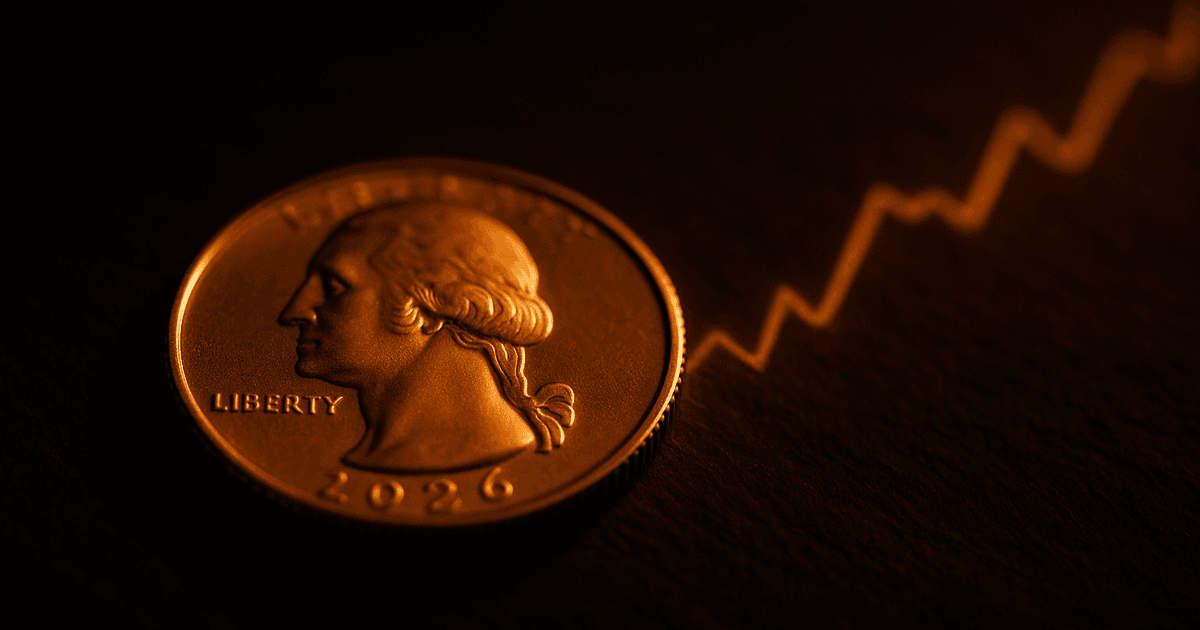
The Headline: A Crowd Shows Up for the Gettysburg Quarter
Coin World reported this week (November 4) that roughly 1,000 to 1,500 people turned out for the launch of the Gettysburg Address quarter on October 21. It is the last of the 2026 anniversary quarters, and it honors Lincoln’s speech rather than a park or a person — which is a different kind of subject for the series, and clearly one collectors wanted to be present for.
The practical date to circle: Mint rolls and bags go on sale November 13, per Coin World. If you sell modern quarters on stream, that is the week your chat starts asking what an unopened roll is worth. The honest answer is that a fresh roll’s value is set by what buyers are actually paying for that release in its first weeks — not by the design, and not by the fact that it’s new. Check the sold comps before you quote a premium, because launch-week premiums on modern rolls can be real, thin, and short-lived all at once.
We’ve been covering the 2026 anniversary quarters all year in our lookup tool, and the same rule applies to every one of them: the design moves eBay sold and active listings, but it doesn’t create per-design catalog values for a modern quarter program. Price the coin, not the theme.
Congress Passed a Nickel Metal Bill
Coin World reported (October 21) that Congress passed a bill allowing cheaper compositions for the five-cent coin, including zinc clad in nickel, as minting costs continue to exceed face value. The same bill also permits transaction rounding and the potential suspension of circulating denominations. Numismatic News’ Patrick A. Heller had already asked the blunt version of the question on October 22: should U.S. nickel production be ended altogether?
Here’s the distinction that matters if you’re holding nickels: this is a manufacturing story, not a numismatic-value story — yet. A change in alloy doesn’t make the nickels already in your junk box scarce, and it doesn’t add a nickel to their value. What it can do, over years, is end a composition era, and composition eras are exactly what collectors look back on later. The wartime 35% silver nickels of 1942–1945 are valuable today because the metal changed and people noticed — not because anyone knew it in 1942.
So the honest read: don’t pay a premium for common nickels because a bill passed. Do keep a roll of whatever the last current-composition year turns out to be, if that’s the kind of thing you enjoy. That’s a cheap bet on a story, not an investment thesis.
The Mint’s $250 Gold Proof Went on Sale November 5
Numismatic News’ AnnounceMints column (October 27) flagged that the U.S. Mint would release a $250 gold proof coinin its semiquincentennial program on November 5 — another entry in the 250th-anniversary lineup that has driven so much of this year’s collector attention.
Whatever you think of the design or the politics of a portrait on a coin, the pricing logic on a high-face-value gold issue is simple and unsentimental: it carries a real metal floor. Gold is above $4,100 an ounce as we write this, and a coin that size is priced first off its gold and second off its mintage and demand. If you’re buying one to flip, know which of those two numbers you’re actually paying for.
Paper Money: A 2027 Printing Order and a Signature Story
Two note items worth passing to the paper side of your audience. First, Numismatic News (October 29) reported that the Federal Reserve’s 2027 printing order calls for no new $2 notes and sharply limited $50 production — a schedule change that historically feeds interest in the denominations affected. Second, Numismatic News (November 3) looked at how the President’s signature appearing on circulating U.S. notes could create new collecting interest, particularly in scarce denominations and star replacement notes.
The lesson transfers straight from coins: when supply of a specific note or year dries up, the ones already in circulation become the collectible ones, and star notes are the easiest thing to check in a strap. Our sister site, LastNoteSold, prices paper money the same way we price coins.
Spot Metals: Gold Back Above $4,100, Silver Still Easing
At the time of writing (November 5, 2026), gold traded at roughly $4,120 per troy ounce — back above $4,000 after dipping under it in late October — while silver sat near $52.74, a touch below where it was two weeks ago, per LastSoldCoin’s live spot feed.
At $52.74 silver, the melt math on 90% coinage works out to roughly $40.79 per Morgan or Peace dollar (0.77344 oz), $19.07 per half dollar (0.36169 oz), $9.54 per quarter (0.18084 oz), and $3.81 per dime (0.07234 oz). At $4,120 gold, a $20 Saint-Gaudens double eagle carries roughly $3,986 in melt (0.9675 oz of gold).
The two metals are telling slightly different stories this week, and that matters for how you price. Gold’s move back up lifts the floor under every pre-1933 gold piece you handle; silver’s drift lower quietly trims the floor under the 90% bags. Neither move tells you anything about what a 1949-S dime or an 1893-S Morgan is worth — those numbers live in comps, not in the spot price.
Market Watch: Steady Prices, Softer Metal-Linked Coins
Coin World’s market watch column (October 7) described a market where most coin prices held steady while metal-linked material — palladium, common-date gold, and Morgan dollars — declined, and scarcer collector coins rose. That is the pattern worth internalizing: when metal prices wobble, the coins whose value is mostly metal move first, and the coins whose value is mostly rarity barely notice.
Also worth a look: Numismatic News (November 4) reported a Danish homeowner’s patio project that uncovered a Viking silver hoard with new clues about 10th-century Scandinavian trade. Not a pricing story — just a reminder that buried silver keeps turning up, and that “found in the ground” is usually a story about condition problems, not jackpots.
What This Means for Streamers and Dealers
Three takeaways. First, mark November 13: the Gettysburg quarter’s rolls and bags are a live-show opportunity, and launch-week premiums are only worth quoting from real sold comps. Second, don’t turn a nickel composition bill into a nickel premium — policy is not rarity. Third, watch which engine is driving the coin in your hand: gold’s climb and silver’s drift move melt floors, not numismatic values, and the two have been running on separate tracks all month.
📖 Related Reads
Price every coin on its own data
Search any US coin on LastSoldCoin. FloorBid gives you the dealer-buy number, BidScore tells you how confident it is — from melt-floor 90% silver to seven-figure rarities. Always visible. Always honest.
Search a Coin →