
The Series You Actually Find
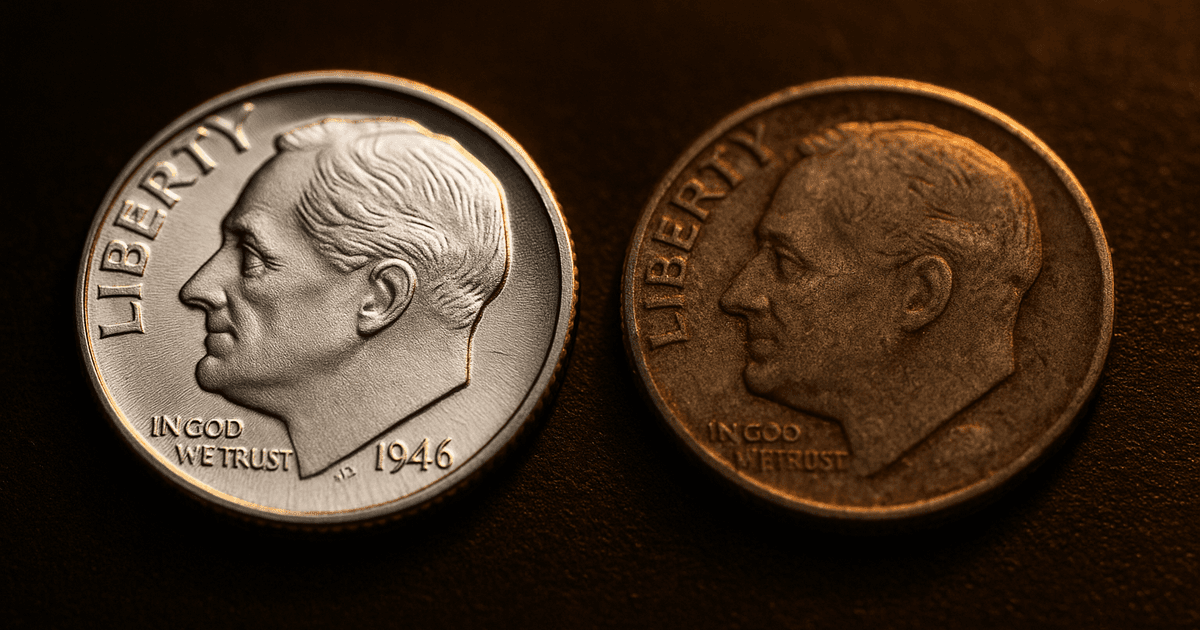
The Roosevelt dime replaced the Mercury dime in 1946, the year after Franklin Roosevelt’s death, and it has been in continuous production for eight decades. That’s the whole reason it’s the most-asked-about dime in our lookup tool: unlike the Mercury series, which ended in 1945 and lives in dealer boxes, Roosevelt dimes come out of parking meters, coin jars, and grandpa’s dresser drawer.
The obverse carries Roosevelt’s profile; the reverse carries a torch flanked by olive and oak branches. The design never changed across the silver and clad eras — which is exactly why so many people assume every Roosevelt dime is silver. It isn’t. The date on the coin is the only thing that settles it, and the line is sharp.
The Silver Line: 1946–1964
Every Roosevelt dime dated 1946 through 1964 is 90% silver. Each one weighs 2.5 grams, and the silver inside is 2.25 grams — a hair over 0.0723 troy ounces of fine silver. That’s your melt floor, and it moves with spot:
At silver near $52.74 an ounce (where our live spot feed had it on November 5, 2026), a 90% silver dime carries roughly $3.81 in melt — about 38 times its face value. At $40 silver, the same dime carries about $2.89. At $60, about $4.34. This is the number that matters when you’re selling a roll or a bag on stream, because it is the one number nobody can argue with.
Above that floor sits a small numismatic premium, and for most silver dates it is genuinely small. Common circulated Roosevelts — 1946-P, 1947-P, 1953, 1964-D, and the other high-mintage years — trade at or a little above melt. A nice uncirculated common date adds a modest premium on top. Don’t let anyone tell you a 1964 dime is a rarity: the Philadelphia and Denver mints struck those in the hundreds of millions.
The Dates Worth Pulling
Five silver dates do most of the work in this series, all of them struck in the low millions rather than the hundreds of millions:
- 1955 (Philadelphia) — about 12.5 million struck, the smallest business-strike mintage of the silver era and the date collectors name first.
- 1949-S — about 13.5 million. The classic San Francisco key in circulated grades.
- 1946-S — about 13.6 million, and the first-year San Francisco issue, which always carries first-year demand.
- 1955-D — about 14 million, and the Denver counterpart to the 1955 key.
- 1950-S — about 20 million. The weakest of the five, but still a date worth setting aside.
We’re deliberately not printing a single dollar figure for these. A 1955 dime in a circulated grade and a 1955 dime with original luster and full bands are not the same object, and the gap between them is larger than the gap between most dates. Pull the comps for the grade you actually have.
The Clad Years: 1965 to Today
From 1965 forward the dime is clad: copper-nickel outer layers bonded to a copper core, with no silver at all. Face value is the floor, and for common dates face value is also the ceiling. That sounds like a dead end, but a few things in the clad era are genuinely worth knowing:
- 1965–1967 have no mint marks at all. The Mint dropped mint marks for three years to discourage hoarding during the coin shortage. Any Roosevelt dated 1965, 1966, or 1967 with a mint mark is wrong.
- 1980 is the first year with a P mint mark on the dime. Before that, Philadelphia dimes simply had no mark.
- 1982 dimes struck without a mint mark are a known transitional oddity from the changeover. They carry a modest premium — real, but nowhere near key-date money. Don’t confuse one with a jackpot.
- 1996-W is the one clad date collectors chase: about 1.5 million were struck in West Point and sold only in that year’s mint sets, marking the series’ 50th anniversary. It’s an uncirculated-only coin, so a circulated one doesn’t exist.
Full Bands: The Designation That Outruns the Date
Here’s the part that surprises people. On a Roosevelt dime, the grading services award a Full Bands (FB)designation when the two horizontal bands across the torch on the reverse are fully separated and show full detail. That is a strike-quality judgment, not a wear judgment — and it can be worth more than the difference between two ordinary dates.
A common 1946-P in a mid-uncirculated grade is an inexpensive coin. The same date with certified Full Bands can command a meaningful multiple, because full strikes on this design are genuinely uncommon. If you’re sorting a collection and you see slabbed Roosevelts, read the label for FB before you read the price. If you’re submitting raw coins, understand that you’re paying for a strike opinion that a grader renders on one day — which is its own kind of risk.
How to Value a Roosevelt Dime in Four Steps
One: read the date. 1964 or earlier means silver; 1965 or later means clad. There is no in-between year. Two: read the mint mark. It sits just above the date. No mark on a 1965–1967 coin is correct; no mark on a Philadelphia coin before 1980 is also correct. Three: judge the surfaces. Original luster, unbroken toning, and clean fields are where the value lives. A polished or dipped dime is a discounted dime, no matter what the date is. Four: price it with comps for that exact date, mint mark, and grade — not with a number you remember from a price guide.
One useful habit: keep the two price languages separate. Retail values — including the CPG retail values published by Greysheet and shown to Pro and Premier subscribers — are retail. They are what a collector might pay, not what a dealer will hand you. A dealer-buy number is the other side of that spread, and confusing the two is how people convince themselves a coin is worth twice what they can actually get for it.
Pricing Dimes on Stream
For a roll of silver dimes, the honest quote is melt times the count, plus whatever premium your buyers are actually paying this week — and that premium is thin and moves. For single better dates, the comps do the talking. For clad, be upfront: a circulated 1979 dime is ten cents, and saying so builds more trust in your chat than inventing a story about it.
That’s the whole point of showing your work. When you can put a melt floor and a confidence score on screen next to the coin, the buyer doesn’t have to take your word for anything — and the seller doesn’t have to defend a number they made up.
📖 Related Reads
Price your dimes with real comps
Search any Roosevelt dime on LastSoldCoin. FloorBid gives you the dealer-buy number, BidScore tells you how confident it is — from melt-floor silver to a certified Full Bands key. Always visible. Always honest.
Search a Coin →